
Videos
The Urgent Work of Our Moment: The Rule of Law & Democracy
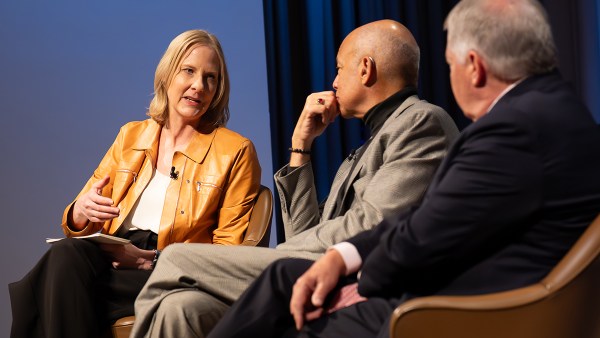
Ford Foundation President Heather Gerken joins J. Michael Luttig, former judge for the U.S. Court of Appeals for the Fourth Circuit, and Jeh Johnson, former U.S. Secretary of Homeland Security, for a conversation on the importance of strengthening democracy, protecting elections, and upholding the rule of law.
How public interest technology erased 21,000 wrongful convictions at once
When the ACLU of Massachusetts joined with a public interest technologist, the odds were against them—yet they scored single largest dismissal of wrongful convictions in U.S. history.
Transcript
ANNOUNCER:Please welcome to the stage Heather Gerken, president of the Ford Foundation.
HEATHER GERKEN, Ford Foundation President: It is wonderful to see you all here and to the many people who are in our audience, I am six weeks into this job. This is the first public event I have done, and I could not imagine a more important topic or more distinguished speakers to engage in this important conversation. So without further ado, I want to announce two people who really need no introduction, but I will introduce them anyway—former secretary of Homeland Security, Jeh Johnson. and judge Michael Luttig of the Fourth Circuit. So I do feel like I should give you just a tiny bit of, of a sense of their resume, but just, to say, Jeh Johnson—obviously the former secretary of Homeland Security. Prior to that, he was the general counsel of the Department of Defense, the general counsel of the Department of the Air Force, and assistant U.S. attorney in the Southern District of New York. He currently serves as co-chair of the board of trustees for Columbia. He’s on the board of MetLife and the 9/11 Memorial. He has had so many awards that if I had to read them all, I could not. We would not have any other time. But I’ll just note, they include the New York State Bar Association’s Gold Medal, the National Law Journal’s Lifetime Achievement Award, the Ellis Island Medal of Honor, and the Ronald Reagan Peace Through Strength Award.
Judge Michael Luttig served on the U.S. Court of Appeals for the Fourth Circuit from 1991 to 2006. He has also served after that as counselor and special advisor to the Coca-Cola company, and on its board from 2021 to 2025. Prior to that, he was the counselor and senior advisor to the Boeing Company and served as executive vice president and general counsel during a period before that. He was appointed to the federal bench by federal—by President George Bush, and prior to that served as assistant attorney general for the Office of Legal Counsel, counselor to the Attorney General, and deputy assistant attorney for the Office of Legal Counsel, as well as assistant counsel to President Ronald Reagan.
And if I just may speak personally, they’re both heroes. These two men are, I think, come from opposite sides of the political spectrum, and have done more than almost anyone I can think of to talk about the issues that are here before us today. They are extraordinary people to have before us. And so I want to spend as much time hearing from them. So, gentlemen, thank you so much for coming. From the bottom of my heart, I so appreciate it. I wonder if we just might start with the big topic, which is the state of the rule of law in the United States. That is kind of an abstract question to a lot of people. It’s not a question that I expected to be asking during my lifetime. But I wonder if you might say a little bit about how you understand what the rule of law is and where you think we are at this moment of time in the United States? So, Secretary Johnson, if I might start with you.
JEH JOHNSON, Former U.S. Secretary of Homeland Security: Thank you. Heather. First, thank you for inviting us. I see in addition to yourself, a number of people here who were part of our task force that authored the report that was put out in August. So, in working through this report and thinking about the issue of democracy, rule of law, I think we discovered that the rule of law could mean different things to different people. Does it mean slavish adherence to existing law in the United States Code and therefore you’re—advocate changes in law as somehow, violating the rule of law? No, of course not. When I think of the rule of law, I think of respect for the law, whatever the law may be, and respect for legal norms as well; respect for court orders, respect for the judiciary; respect, of course, for the letter and spirit of the U.S. Constitution. And not—and for my executive branch experience in the law, the way I answered the question is: In advising clients, the president, the secretary of defense, your charge, your responsibility is to advise that—come up with the best legal position that is most sustainable, defensible, that seems to be in the center of the weight of authority on some difficult proposition and not simply, “Well, there’s an argument that we could make, and the court may or may not buy it. Let’s see what happens.” Which frankly, I think is the attitude that seems to prevail, “Just kind of throw it up against the wall and see what sticks.” And so I interpret the rule of law to mean doing your best to interpret the law as it exists. So I’m sure Judge Luttig has a view on this too.
HEATHER GERKEN: Judge?
J. MICHAEL LUTTIG, Former U.S. Appeals Judge: Thank you, Heather, and thank you for this wonderful occasion and event. This is needed, and it’s an important event. The rule of law. Let’s start at the—at the beginning. Next year, America will celebrate its 250th anniversary since its founding. So almost 250 years ago, the American colonists declared their independence from King George III and the British Crown because of the oppression that they were experiencing from the British Empire. They declared their independence and they fought the Revolutionary War to secure that independence from the British Crown. They did that in order to establish a new nation and a new government. For the first time in civilization, they created a government of laws, not of men. They embodied that in the Constitution of the United States a few years later. The rule of law—there is a definition, and a universally agreed upon definition, of the rule of law. And that definition was established by the United States of America in our Constitution. And it’s very simple. And we’ve agreed upon that definition of the rule of law for almost 250 years, until today. That definition is very simple. The laws are those embodied in the Constitution and the laws of the United States, as enacted by the Congress of the United States and approved by the President and entered into the United States Code. Americans, for 250 years have respected the rule of law. They’ve respected the Constitution of the United States and the laws of the United States, as interpreted by the Supreme Court of the United States, and we have unfailingly abided by those laws until today. What’s going on today is not a debate about the nuance of the laws or the appropriateness of individual laws. Don’t let anyone tell you that. Today in America, the law itself is being challenged by people who are self-styled as revolutionaries. The only problem is that once we adopted the Constitution of the United States, it’s not an option to revolt against the United States of America and the Constitution of the United States.
HEATHER GERKEN: Thank you. I appreciate—[applause]
One of the things I appreciate about having both of you up here, and Secretary Johnson, when you were describing that it’s not about any legal argument is, I used to teach law students for a living, and I always would tell them that the rule of law is what happens when the most argumentative people on the planet argue for centuries, and what’s left standing is where there is no argument on the other side.
And so that if two people from very different political views can’t agree on it as a rule of law, it’s not the rule of law. It’s just what you want to be enacted as a preference. But the rule of law stands because lawyers for generations on both sides of the aisle have agreed about its fundamentals. It’s assiduously nonpartisan. I wonder, Secretary Johnson, you’ve been writing about the rule of law as recently as this week. I wonder if you might talk a little bit about what you are most worried about at this moment, and some of the things that are top of mind for you?
JEH JOHNSON: What I’m worried about in terms of our democracy, I think we’re discovering that it’s not just—to sustain our democracy—it’s not just adherence to the strict letter of the Constitution, the strict letter of the oaths that we took when we entered public office, but also adherence to legal and constitutional norms, and electing people to high office who respect and understand legal and constitutional norms. There’s a lot of gray in the law and in the Constitution.
I like to point out that the First Amendment contains just 43 words, but it embodies the principles of freedom of assembly, freedom of press, freedom of religion, and freedom of speech. But if you don’t respect that rule of law and you read it and you say, “You know what? Let’s give it a shot and see if the Supreme Court will agree.” That’s a real challenge to our democracy. And it is for that reason that our democracy is under attack right now.
HEATHER GERKEN: Thank you. Judge Luttig, what is—keep you, keeps you up at night?
J. MICHAEL LUTTIG: Well, I want to sharpen my earlier comments, if you’ll permit me. When I say there’s a definition of the rule of law, you know, I mean, what I’m talking about. If there is a silver lining to the past decade of vicious attacks on the Constitution of the United States, the laws of the United States, and the federal judiciary, it is this: The attacks themselves are so bold that they are attacking that which is unattackable as a matter of law. The lower federal courts of the United States have struck down every single one of those initiatives as being unconstitutional on its face, or otherwise in violation of the laws of the United States. My point being, we wouldn’t be here today if any of these issues, much less all of them, were debatable—good faith and—debatable in good faith among legal, legally knowledgeable persons, including the courts.
HEATHER GERKEN: I want to talk a little bit about democracy, as well. I came to the Ford Foundation because the work of this moment is the work of my life. It is also the work of the Ford Foundation. So, Ford Foundation, back during the McCarthy period, stood up, protection for free speech and dissent. It funded a good portion of the civil rights movement. It built out the backbone for public interest law, human rights law, even—close to our hearts—legal clinics. All of this was done by the Ford Foundation for many, many generations. I had the honor of serving under both of your leadership on the American Bar Association Task Force for American Democracy, which was an astonishingly distinguished group. And I wonder if you might just give us some sense of your own view of what is the current state of our democracy, particularly our election system?
JEH JOHNSON: First of all, you mentioned the McCarthy era. My grandfather was a sociologist during the McCarthy era and lived in the South, was the president of Fisk University in Nashville. And when you were a Black man who wrote a lot about civil rights in the late ‘40s, early ‘50s, you were a suspected communist. So the grandfather of the future secretary of Homeland Security testified before the House Un-American Activities Committee in 1949 and has an FBI file. Jim Comey sent it to me one day when I was in office with a little note from his assistant, “The director thought you might find this interesting.”
[laughter]
And so, sure enough, first page is a memo issued by J. Edgar Hoover directing an investigation of my grandfather, and then the report back has the results, “Charles S. Johnson is a patriotic, well-meaning individual. If he has one fault, he tends to, he tends to associate with disgruntled people.” That would be other Black people in the South. Yes. Right. So, my, when it comes to our democracy right now, one of the, the central point of our report was to not look at each individual outrage and crisis. It was an effort to examine the undercurrents of our democracy.
And we wanted to put forth recommendations that would be as relevant today as they are five, ten, fifteen years from now. So, for example, one of the recommendations is citizen redistricting commissions—have citizens, not politicians, create legislative district lines. And we put that recommendation in the report even before this mid-decade fight we’re in now in Texas and California and elsewhere. Because we found that when you put to the citizens on a ballot referendum, “Would you like to have citizens draw legislative district lines?” It’s wildly popular, and it exists in a number of states now. And there are other recommendations, like open primaries, because the, our view is that part of our problem with our democracy—why Americans are so suspicious of government, fed up, dismayed—is that our our political leaders feed that and pander to that and encourage that because they have to appeal to their own political extremes in order to get reelected.
In the House, there are 400 out of 435 safe seats. And if you’re a Democrat, you worry about a challenge from your left. If you’re a Republican, you worry about a challenge from your extreme right. So one of the recommendations we put forth is open nonpartisan primaries, where every candidate runs on the same ballot in the same primary, and then the 2 or 3 top vote-getters, run in a runoff, which re-incentivizes politicians to appeal to the political center and not the political extremes.
And when it comes to our election itself, our election infrastructure itself, in 2016, we were very worried about the Russian government attempting to hack into our election infrastructure based on the intelligence we were seeing. And I spent a lot of time with state—secretaries of state encouraging them to seek DHS’ assistance in their cybersecurity, which they did. And over 30 states in the fall of 2016 came forward and sought our help. And that work continued into 2017, 2018. So there are two pieces of good news. One, I think that the cybersecurity of our election infrastructure is better now than it was, say, eight or nine years ago. And levels of voter participation have been going up. But, particularly with the advent of AI, I think, and I’ve heard other experts say this, that those on offense—in cyber—have a distinct advantage that is widening the gap between those on offense and those on defense because of AI. You know, I always ask the question in boardrooms and whatever, “has AI helped us close the gap between offense and defense or is it widening?”
And the answer I get is that it’s widening. And so there are new challenges to the cybersecurity of our democracy that we have to confront. The other piece of good news, I’ll say, is that when we went on our listening tour for the ABA, we discovered there were a lot of dedicated election workers at the local level who take a lot of pride in their work. But there, the problem is state-level election officials, like secretaries of state, are becoming increasingly political and politicized. And so the people we count on to be even-handed in counting our votes are becoming increasingly politicized. And that’s a big problem.
HEATHER GERKEN: Judge Luttig, I’m curious, what do you think about the next election that’s coming?
J. MICHAEL LUTTIG: Well, I first want to say this, you know, as I was just listening to your introduction to this question, you know, I was thinking: if the national treasure of the Ford Foundation, has ever had a reason for being and a purpose for its work, it’s today. Because America’s democracy and its rule of law, the cornerstones of the republic are under vicious attack and in peril still today, if not in greater peril today than they were yesterday. metaphorically. So, on democracy, as I mentioned, we’ve been the envy of the world for 250 years, and for good reason. This is the greatest experiment in self-government and governance in, in, in all of civilization.
You might be tempted to say that we took it for granted for 250 years. I don’t—I’m not of that school, we didn’t take it for granted, though we never had any reason to think that these days would come here. But they have. And so that’s why the—we are all being called for the first time in our life and presumably the last time, unless we don’t answer the call, we’re being called upon simply to defend our country. From what Abraham Lincoln might call the enemy within. And unfortunately, we would have never imagined, but it actually takes courage to defend our country today. And if we don’t summon that courage from deep within now, we won’t have another opportunity.
HEATHER GERKEN: Well Judge Luttig, I appreciate the call to Ford. I want you to know we are answering that call. And in many ways, bottled on some of the quieter work that you two did and the commission, the task force, did. You know it produced a report with extremely important recommendations about our democracy, but leading up to the election, it also did the work of shoring up the very election administrators, the everyday people who are under unbelievable forms of pressure these days because of political polarization, because of the, the ways that we treat our elections these days, the distrust of institutions. And so, I’m very happy to say, consistent with the bipartisanship of this panel, that I am finding partners from across the ideological spectrum. You know, there are people on both sides of the aisle who are standing up to do the work to ensure that election administrators just have the freedom to do their jobs safely and securely, to make sure that ballots are counted, to make sure that we, just people have a chance to cast their ballot without fear of intimidation. But I wonder if you might just talk a little bit about some of the work that the commission did, because it was really important. And in some ways it was less glamorous than some of the work we think of with democracy. But I wonder if you just might talk a little bit about how can we—and particularly lawyers—support election administrators across the country as they face a set of challenges that are really, I think, unknown in prior years?
JEH JOHNSON: Well, we did this project for the ABA, but it’s not all about just lawyers. We had on our task force people who were not lawyers, and those who are fundamental to our democracy are not just lawyers. One of the things that struck me when we’d go out on this listening tour, which we did in swing states—and we’d get an audience about this size—and the age of the audience was about the age of this group. And I don’t mean that as an insult. What I mean is, you ask yourself, where are the—where are the 24- or 28-year olds or the 30-year olds who are worried about the future of our democracy? One of the most alarming things I saw in polls is that younger people, younger Americans question at higher levels the importance of democracy because they don’t have the historic arc that people our age do and, so I think, I think our task is to mobilize and motivate younger Americans to be as concerned as we are about just how frail our democracy really is. College students, those who are in graduate school, those who, you know, are working a job at age 23, who only know in, in their political memories, the last eight years or so. I think our task is to pass on to the next generation the importance of our democracy, we can’t take it for granted. And the importance of sustaining our democracy, it requires work to sustain a democracy. If we elect somebody who does not respect democracy, does not respect democratic norms, we’re in real trouble. And Americans my kids’ age—that really is all they know.
HEATHER GERKEN: Judge Luttig?
J. MICHAEL LUTTIG: Well, another tranche of alarming statistics of the kind that Jeh just mentioned were statistics that showed that, the two political parties in America, neither trusted democracy. Think about that. Now, on that, you know, I—you know, I have not made any bones about the fact that, you know, I place full responsibility on our elected officials. And so maybe you heard me say once or twice that going back to the fundamentals, because that’s what these times call for, all power in the United States of America rests and resides with “We the People.” These politicians that we elect to represent us—they have zero power. When we elect them, we effectively loan them our power to act in the national interest and in our interests. Not their individual political interests and personal political interests or their party political interests, but in the nation’s interests. And every day of the week, those men and women in the Congress and elsewhere in Washington are required to choose between the national interest and their own interests. And I’ve said—you may agree with me or not—it doesn’t matter to me—every single day they choose to act in their own interest, not the nation’s interests.
HEATHER GERKEN: If I may talk a little bit about social media and the role that it’s playing, both on, on the national stage with national security concerns and the election system. Because I think people just don’t know how many safeguards there are to ensure the system works properly and that votes are counted properly. And when feelings are high and conspiracy theories are running amok on social media, this stuff can get amplified very, very quickly. I wonder how you think about that problem?
JEH JOHNSON: So often, your greatest strength is your greatest weakness. And our greatest strength in this democracy is freedom of the press. And the positive aspects of social media are that people are more engaged. But then you have to ask, engaged how? Engaged in what direction? Engaged reading what? Consuming what? And when—when he and I grew up, you got your news from the three networks who had basically the same journalistic standards, and the local newspaper, and the local AM radio station, and the local TV station, and they all adhered pretty much to the same professional standards.
Now with social media, the, the, the barriers to entry and exit are non-existent. It’s anybody with a keyboard. And we are drawn to, in our consumption of information, we’re drawn to—and this is human nature to a large extent—we’re drawn to things we already agree with. So when I—if I turn on the TV at night, I can watch cable news, very opinionated cable news, or I can watch PBS. And one is like consuming a Hostess Twinkie, and the other one’s like consuming a piece of wheat bread. And—but the wheat bread is going to educate—is better for me.
And so, we’re in a situation where half the world believes, you know, that, that, that, this room is red and half the world believes this room is green. And, because somebody told them that, which leads to a divided society. And so I think the task is for—so much of this tracks back to the American consumer himself or herself accepting responsibility for being a participant in our democracy and not just being, you know, a consumer of the, some of the crap we read and see; accept responsibility for scrutinizing yourself some of the stuff that is pushed at us on a daily basis. Ask questions, second guess an opinion. Sometimes you’re consuming an opinion from a very opinionated news source that is no better than your own opinion. We need more honest brokers in terms of the people who command a microphone, who have a public voice. We need more honest brokers of information. And there are far, far too few right now. And that, I think, is a big, big part of the reason we are where we are in our democracy today.
J. MICHAEL LUTTIG: You know, I’m—I won’t get into television because I, I don’t even know how to turn on a television. And these days, I’m glad of that and proud of it. But, where Jeh ended up is what I want to speak to. There are facts and there are fictions. There is truth and there is falsity. There is honor and there is dishonor. And there’s honesty and there is dishonesty. And those have forever been distinguishable, one from the other, and they have forever been distinguished, one from the other, by mankind. They will forever be distinguishable, and forever distinguished, no matter what anybody in America is telling you or telling us today. And you want to get down to the fundamentals? Those are the fundamentals in America today.
HEATHER GERKEN: Well, I am sad to say that we’re going to need to conclude this panel. But I think I just want to close by saying one thing, because I think that for people who have worked in the democracy, rule of law space, it’s been a tough, tough period. And so I often get questions nowadays, “How are you? No—how are you?” And the answer for me is—I am happier than I have ever been in my career because every morning I get up and, you know, foundations do the work that makes the work possible. And right now I am spending almost every minute of every day talking to people who are doing the extraordinary work of protecting the rule of law, protecting our democracy, from every part of the political spectrum. And they are doing it bravely. Among those people, I just want to say that the two of you have been brave and honorable and honest, and we are all—we have in debt for the service you gave to this nation before now. But I just want to say that at this moment, your willingness to stand up, to speak the truth, and to protect this country are unfailingly inspiring. And I just wanted to say thank you from the bottom of my heart. Thank you.
[applause]
[The Ford Foundation logo is stacked in a serif font, then transforms into a single letter “F” set inside a circle.]
Accessibility Statement
- All videos produced by the Ford Foundation since 2020 include captions and downloadable transcripts. For videos where visuals require additional understanding, we offer audio-described versions.
- We are continuing to make videos produced prior to 2020 accessible.
- Videos from third-party sources (those not produced by the Ford Foundation) may not have captions, accessible transcripts, or audio descriptions.
- To improve accessibility beyond our site, we’ve created a free video accessibility Wordpress plug-in.
Video collections
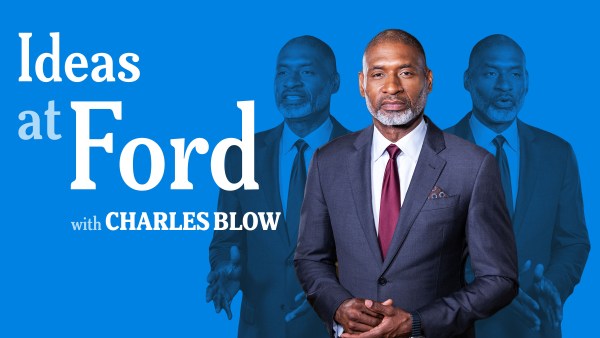
Ideas at Ford
Hosted at the Ford Foundation Center for Social Justice by New York Times columnist Charles M. Blow, Ideas at Ford is a conversation series exploring complex social justice issues and solutions.
New Gospel of Wealth
Transforming philanthropy for the 21st century requires a bold vision: one that moves giving from generosity to justice. Generosity is focused on helping someone in need; justice is about solving the problems that created the need. This series features leaders sharing their thoughts about the future of philanthropy.
On What Matters
#OnWhatMatters is a conversation series between Ford and social justice leaders on the frontlines of change.
InequalityIs
In the #InequalityIs video series, a wide range of people define what inequality means to them, covering the many challenges that need to be overcome in the fight for equality, justice, and dignity, and creating a future of work that works for all.
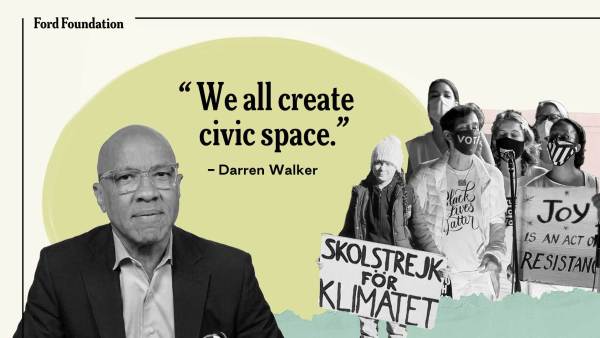
Independent Videos
Ford Foundation produces videos about a wide range of critical topics to advance justice.
Disability Demands Justice
Without disability justice, there can be no racial, economic and gender justice. Real change requires that no one is left behind. Tackling inequality with an intersectional lens can help create a fully inclusive world.
The BUILD Program – Flexible Long-Term Funding
Our Building Institutions and Networks (BUILD) initiative is a grantmaking approach focused on helping social justice organizations become stronger and more resilient over time. BUILD provides flexible funding and fosters connections to other organizations working with ideas that are changing the world.

Art Is Justice
Art has limitless power to dismantle inequality and help bring about positive social impact. This series pays tribute to the musicians, the dancers, the actors, the writers, the visual artists, and the painters, as well as the grassroots organizations and activists, who are using art for social change.
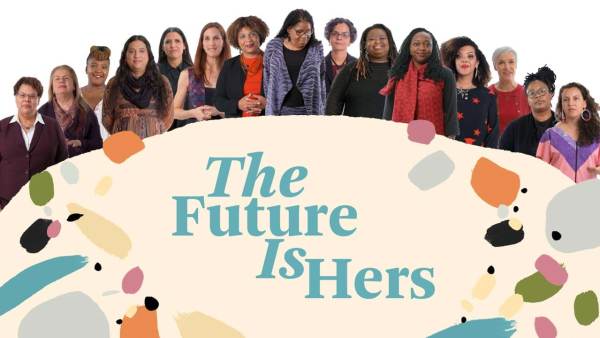
The Future Is Hers
Around the world, women have become an unstoppable force for social change. They are rising up to create solutions to the biggest issues facing society, from institutional racism to abortion rights. In the #FutureIsHers, we spotlight the women rewriting the rules, redefining power and reimagining what equality looks like.

How can Public Interest Tech change our world for good?
Public interest technologists work to ensure tech is for the public good and helps dismantle inequality. This series shows how a team of talented and dedicated people across academia, civil society, government and private sectors needs to be involved in bridging the gap between technology and social justice.
How the Ford Foundation uses grants to tackle inequality
Everyone deserves to contribute to society, have their voice heard, and fulfill their potential. Dismantling the systems and structures that prevent people from these opportunities is core to Ford’s work. Through our endowment, we make grants, mission-related investments and program-related investments to support organizations working to tackle inequality.