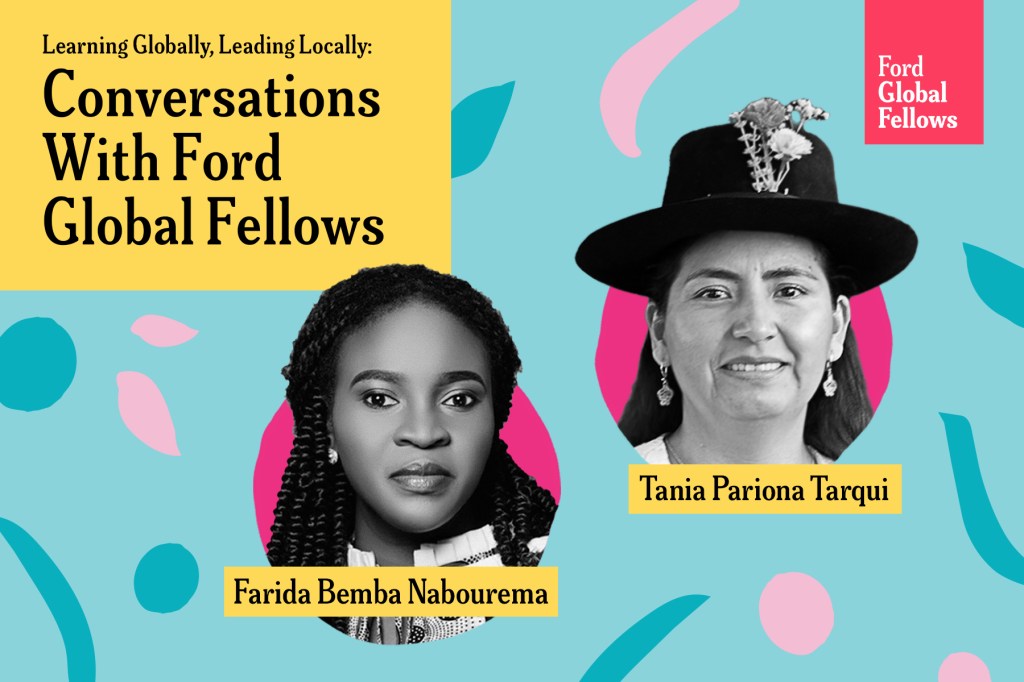
For women who lead social justice work, the fight rarely happens on a single front. Alongside the public advocacy for historically excluded communities’ rights and representation, there are more personal battles: asserting their own legitimacy and power within spaces meant to stand for equality. This dialogue, part of Ford Global Fellows’ “Learning Globally, Leading Locally: Conversations With Ford Global Fellows” series, brings together two women whose advocacy began in their youths and whose leadership has been tested by both the systems and people around them.
Farida Bemba Nabourema is the executive director of the Togolese Civil League and one of the most recognized human rights advocates in Togo. Her work sits at the intersection of human rights, civic responsibility, and decolonization; specifically, she focuses on how colonial-era structures of repression have continued into the present, concentrating power among ruling elites while stripping low-income communities of resources and dignity. Farida began her activism at just 13 years old and has spent more than two decades organizing for the rights and representation of historically excluded communities in Togo.

Learning Globally, Leading Locally
This post is part of a conversation series with Ford Global Fellows.
Tania Pariona Tarqui is an Indigenous Quechua activist, feminist, and human rights defender from Peru; she currently serves as executive secretary of the National Coordinator for Human Rights, a coalition working to defend human rights across the country. She has also been a member of the Continental Network of Indigenous Women and previously held elected office. Her work focuses on the empowerment of Indigenous women and leaders and centers communities facing overlapping rights violations, including women, the LGBTQ+ community, people with disabilities, children, migrants, and Afro-descendant peoples. She began organizing as a teenager in response to a massacre her community experienced, a case that took nearly 40 years to reach a legal verdict.
Farida and Tania work in different regions and contexts, but they both came to community leadership as young women motivated by injustices they witnessed directly. Both have faced discrimination not only from those in power but from peers within organizing spaces who questioned whether they truly belonged. In this conversation moderated by Adria Goodson, director of the Ford Global Fellowship, they discuss how they have persevered, building networks of women and staying visible to guide the next generation of leaders emerging around them.
Entering the Fight and Navigating Exclusion
Adria Goodson:
“Can you describe what it has been like for you to be a female leader in the context that you’re in? What have you navigated to become the leaders that you are today?”
Farida Bemba Nabourema:
“When I began my journey into fighting for human rights, I wasn’t even conscious of my female identity yet. I started at the tender age of 13; I was a teenager, coming up as a woman, and I got involved because of a huge level of injustice in my country that I just couldn’t fathom. Little did I know at the time that the simple fact that I am a female was going to determine a lot of things for me about my trajectory as an activist.
When I started university, I decided to organize a protest for our country. I reached out to some other activists that I have always admired, who were known as being some of the first people that stood against inequality in our country. One of the people that I approached, who I had a lot of respect for, asked me, ‘How old are you, and what do you do?’ I told him that I was 19 years old and a college student. He replied, ‘This is not a fight for young girls. Go find yourself a boyfriend and leave this issue to us, your older brothers.’
That answer really shattered me. It really made me angry because I could see that the injustice, the abuse, did not discriminate on the basis of gender. Claiming that as women, we didn’t have a space in this community was heartbreaking because it wasn’t coming from the institutions or the people that we were accusing of the human rights violations. It was coming from the people that were supposed to be fighting for equality, for justice, for freedom. It showed me that, as women, we have to even fight for the right to speak about our issues.”
Tania Pariona Tarqui:
“I feel that I have experienced similar layers of exclusion in all stages of my life. The voices of children are not always taken into account. When I was young, I was discounted because I lacked experience. Then when I was a woman, I was discounted because I don’t have children, or because I didn’t get married, or because a woman’s job is to be at home, doing domestic things—including listening to male politicians and authorities who are trying to say that women’s place is the kitchen, not in decision-making.
And I have been discounted because I am Indigenous. I believe it is not very easy to exercise leadership when you are an Indigenous woman and you also carry the full weight of racism. In the world, [intolerance] is very strong against diverse cultures, against diversity itself, against the different worldview.”
The Cost of Staying Visible
Adria Goodson:
“What did you call upon in yourselves or in your community to do this work, that might help other teenagers who are looking to make the world a better place?”
Farida Bemba Nabourema:
“One of the ways that people always go after women is attacking their sexuality. It’s funny that both men and women have sexualities, but it is always the women that they target when it comes to their sexuality, because it is a way of shaming women. So I received a lot of attacks on my sexuality, on me being a woman; there were even websites created with my pictures on it saying ‘Farida Nabourema Escort Girl Services.’ Doctored pictures of my face on the body of naked women circulated online.
There was one message that I received one day that really broke me. It was a woman who reached out after seeing some of those images. She was so heartbroken, and she said, ‘I can’t believe they are doing this to you, and they are trying to tarnish your reputation in this way. It is so despicable. This is the reason why I will never allow my daughter to go into politics.’
That was a wake-up call for me, because for the whole period where I was receiving abuses and attacks, I kept being strong, thinking that ignoring it and acting as if I wasn’t bothered was enough to prove that I am strong. For me, being strong was supposed to be an inspiration for other girls, so I thought I was making a sacrifice for other girls so they wouldn’t be discouraged, only to find out that I was becoming the example mothers are using to discourage their daughters from entering politics. That was the moment that I started becoming vocal about those issues. I became intentional in making sure they understood that their attacks were not hurting me, but that I wasn’t going to allow them to continue them, simply because they wanted to use me to discourage other women.”
Tania Pariona Tarqui:
“At one point, it was even doubted that I had gone to school, because when we wear our traditional dress or our traditional hat in Peru, people believe that one did not go to school, or that one is illiterate or ignorant. On several occasions, I was asked if I had studied anything. Of course, that causes indignation in me because people believe that Indigenous peoples are not capable, we cannot achieve that educational goal, and we cannot hold decision-making positions. That is a constant.
And yet, we Indigenous women have demonstrated that we are the moral, ethical, cultural, and knowledge reserve that defines us today as women capable of transforming inequalities and the multiple dimensions of exclusion.”
Sources of Strength and Furthering Inclusivity
Adria Goodson:
“This harkens back to Du Bois’ double consciousness for also being Black and a leader; there are multiple layers here, including the extra labor to lead for people of color. You have both been in this work for over 20 years and have had tremendous impact in this space. You both have had to persist through what is egregious violence and behavior, from both your fellow activists and people who judged you as not fit in these decision-making roles.
What would you like other women to know about you and your leadership?”
Farida Bemba Nabourema:
“In the face of injustice, when people are being bullied, it takes people with privilege to step in, to support the ones that are being the victims of the bullying. There were men, much older men, who said, ‘Hey, this girl is saying something that is important. She’s doing work that is important. You should find ways to support her.’
Inclusivity is not about screaming, ‘Hey, we have space here, you should join us!’ Inclusivity sometimes requires you to create the space and bring others to the table. It’s not just about declaring that you have a seat available; it’s about bringing people in and holding their hand.”
Tania Pariona Tarqui:
“I started as a very young child, seeing very violent scenes and contexts. The least we want is for the new generation not to repeat that history. And yet I want to point out that sometimes I feel that the recognition of activism and leadership is always done on the basis of this resistance: of showing ourselves strong, of enduring injustices, of enduring impunity. Hopefully we will reach a time when the paths of leadership and recognition are exercised in an environment without violence, where we are given equal recognition as any other citizen.
In my life, I have been surrounded and embraced by very wise Indigenous women from Latin America, from Asia, from Africa, from my own community, from my family. We believe that spirituality and healing is also a form of resistance against colonization, and against the new forms of colonization that emerge in these times with discourses that ignore the right to diversity, that dispute collective rights, that disregard the value that we women also hold within Indigenous worldviews.”
The Power of Testimony and Creating Sisterhood
Adria Goodson:
“What are your final words to those who are joining this conversation?”
Tania Pariona Tarqui:
“I have been a witness to many emerging leaders in my town, listening to the testimonies of sisters. Even without realizing that we are leaders sometimes, women demonstrate with every action that it is possible to change this world, that it is possible to move towards a planet without inequality, that does not generate gaps or create fissures for not accessing the same possibilities. To all women of all diversities, of all cultures: Tell them that a positive path is possible, a better one is possible if among ourselves we weave a path of dignity, where we are also seen as subjects of social, political, economic, cultural rights, from a holistic vision. We can create a sisterhood among all peoples of all continents. I think that is the message that the Ford Global Fellowship truly gave me, because it is a huge community where despite the geographical distances, there are many connection points, many paths of life that can make us more dignified human beings.”
Farida Bemba Nabourema:
“There are the visible fights that we are leading, the ones that are specifically targeted at the issues, the poverty, the human rights violations, the inequality, the injustice. And then there are the invisible fights that are more symbolic. The ones that you cannot specifically point a finger at, but that define how people relate to power, and that define whether people want to be involved or not. And you have to be conscious about your choices to ensure that both the visible fights and the invisible fights are leading you into mobilizing your people and into bringing more people into that space where you can actively impact change.”
Note: This article includes responses from Tania Pariona Tarqui that were translated using AI software.