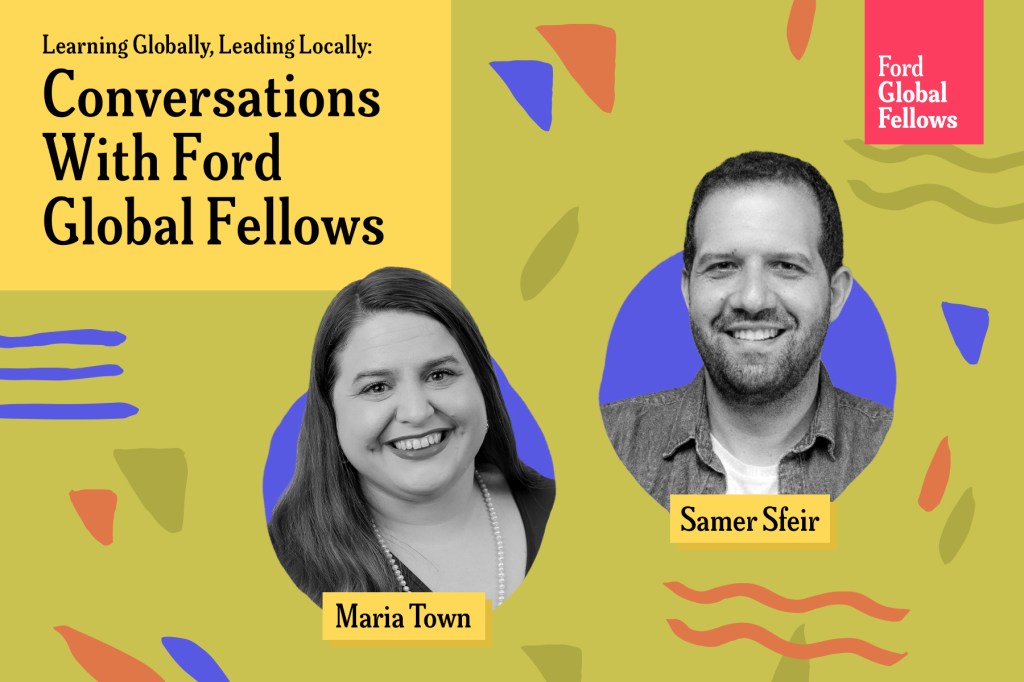
Economic power is one of the most direct paths to dignity, yet for people with disabilities, it often remains elusive. This dialogue, part of Ford Global Fellows’ “Learning Globally, Leading Locally: Conversations With Ford Global Fellows” series, brings together two fellows who are each broadening economic opportunity for disabled people—one of them expanding accessibility and consumer power in the United States, the other building entrepreneurship pipelines and inclusive procurement in Lebanon. They share a conviction that disabled people are not meant to be beneficiaries of other people’s decisions, but builders of their own enterprises and futures.
Maria Town is the president and CEO of the American Association of People With Disabilities (AAPD), a cross-disability, disability-led civil rights organization advancing the political and economic power of the more than 70 million disabled people across the United States. Maria leads an organization staffed and governed by disabled people, and much of her recent work centers on the Access Coalition, a partnership with corporations to open up new territory in accessibility that current ADA compliance doesn’t yet address. Maria was selected as a Ford Global Fellow in 2020.

Learning Globally, Leading Locally
This post is part of a conversation series with Ford Global Fellows.
Samer Sfeir is a Lebanon-based social entrepreneur and the managing director of ProAbled, a resource center for innovative disability inclusion solutions. Trained as a computer engineer with an MBA and currently completing a DBA focused on social entrepreneurship, Samer left the industry to build nonprofits rooted in the belief that people with disabilities are professionally abled, and that opportunity unlocks potential. His recent work includes launching Lebanon’s first full university course on disability inclusion and running entrepreneurship programs that support disabled entrepreneurs. Samer was selected as a Ford Global Fellow in 2025.
Maria and Samer lead very different organizations that both focus on building new pathways to opportunity where old systems fall short, whether that means redesigning a restroom or reimagining an entire economy’s approach to disability. In this conversation, moderated by Ford Global Fellowship director Adria Goodson, they discuss the “tyranny of low expectations,” mothers who dream big for their children, and about what becomes possible when two leaders, working an ocean apart, discover how much of their work is in harmony.
Disrupting Inequality Through Design
Adria Goodson:
“Can you tell us a story about your work and how you are working to disrupt inequality?”
Maria Town:
“My organization, the American Association of People With Disabilities (AAPD), is a cross-disability, disability-led civil rights organization that works to advance the civic and economic power of the more than 70 million disabled people across the United States. By cross-disability, what I mean is that we don’t focus on a specific disability type or experience. Secondly, and very importantly, we are disability-led. I have cerebral palsy. Everyone on our staff is disabled. The majority of our board members are disabled, and all of our executive committee are people with disabilities. AAPD really exists to elevate the lived experience of disabled people.
One of the things that we’ve started working on recently is something called the Access Coalition. What we know of as ADA compliance actually still leaves a lot of access needs out. And compliance is great, but it is the floor, not the ceiling. So in January 2025, we brought teams from corporations to Bentonville, Arkansas, to do a design workshop where we had disabled people and disability advocates take them to all their stores to see that their compliant restroom, for example, actually means that I can’t use the bathroom. Then together, we redesigned these to what an ideal restroom would look like.”
Samer Sfeir:
“I started as a computer engineer, unrelated to anything related to any social justice. I worked with multinational companies, but I felt that there was something missing. So I decided to drop that career and learn about social entrepreneurship. In 2012, my partners and I started our nonprofit shareQ, which is ‘participate’ in Arabic, based on the idea that if you believe in people, you empower them.
In 2016, we started ProAbled, in our belief that people that have a disability are not disabled; they are professionally abled. Universities in Lebanon said that they would not have a full disability inclusion course, because students would get bored—but earlier this year, we got the approval from two major universities in Lebanon to provide disability inclusion courses. And it’s experiential, gamified, and all includes high technology with experiential learning. So instead of seeing people with disabilities at the end of the beneficiary chain, they are now at the beginning of the supply chain as entrepreneurs, employees, and managers. We know that what we’re doing could be symbolic for many countries yet it is a validation model that can be scaled and replicated worldwide.”
Rethinking Benefits and Dependency
Maria Town:
“I think disabled people generally have an extremely high appetite and capacity for innovation. Samer, I would love to learn more about what the entrepreneurship and disability landscape looks like in Lebanon. A frustrating experience here in the U.S. is that entrepreneurship is often a very highly recommended employment strategy for people with disabilities because we experience so many barriers in the traditional, competitive job market. But because of our benefits programs that force us to be in poverty, we can’t get access to capital.”
Samer Sfeir:
“Benefits in Lebanon for people with disabilities are almost nonexistent, so the challenge is that we need to find our own solutions. If people do not employ people with disabilities, the system needs to be fixed in another way. And people want to be entrepreneurs. We’re now gathering around 50 entrepreneurs, and we know their products and services; we’re trying to campaign for all of them together, and we’re calling this inclusive procurement. This is a sustainable model for growth, rather than just knocking on doors and begging authorities to do something.
What we proposed to the Ministry of Social Affairs in Lebanon is that current systems have been creating dependency, and it should be the other way around, which we call the graduation approach. If you want to get support, and you have members that can work, these people need to be doing training, internships, and getting on the path to become independent in order to get the support.”
Maria Town:
“We had a similar charity problem in the U.S. Growing up, I was on benefits, and for a lot of disabled kids, their families actually tell them, ‘You won’t be able to get a job because you’ll lose your benefits, and you need to keep your benefits.’ We call that the tyranny of low expectations. But my mom dreams big; she’s a Pisces. And she knew I was always gonna do whatever I wanted, so I was able to transition off of benefits. I didn’t have fear when applying or going into an interview room. I didn’t have a fear of success. Because I assumed I could do it, you know?”
The Power of the Purse
Samer Sfeir:
“After 14 years and pushing more than 350 companies to adopt disability inclusion and employ people with disabilities, I realized that out of goodwill, 10% would do it. And 90% would just tell us, ‘We’re gonna see what we’re gonna do, blah blah blah,’ and they won’t do anything. I realized we need to leverage elsewhere—and with the world changing, people with disabilities are the new growing community of consumers. So how can we leverage the purchasing power of people with disabilities to bring in real inclusion in the private sector? It’s by power, not by the 10% goodwill. I believe that the economy and the private sector is driven by power, and power can be good.”
Maria Town:
“I have spent 15 years trying to convince people to believe in the consumer power of disabled people. One reason I think the consumer power argument has had limited success in the United States is because there is still such significant ableism that impacts everything we do. The other is the fact that the majority of people with disabilities here don’t identify as disabled. But I do have a lot of research on this, and the data show that companies that market and are more inclusive of disabled people earn more.”
Samer Sfeir:
“Ten years ago, the number of tourists with disabilities who traveled internationally was 8 to 9 million. This year, it was 27 million, and they spent something like $54 billion. Do you think that things are changing?”
Maria Town:
“I think it could be. The number of disabled people in the United States 10 years ago was 60 million; now it’s 70 million, which is huge growth—and that, in my opinion, is an undercount. I do think that the potential consumer power of this group could grow massively.”
What the Fellowship Makes Possible
Adria Goodson:
“What have you learned in your experience as a Ford Global Fellow? And is there any final piece of guidance you have for anyone who is trying to make positive changes in the world?”
Maria Town:
“One of the conversations that has really stuck with me across a number of years was a fellow-driven conversation on justice. It became very clear that justice as a word, as a concept, and as a set of practices all meant something very different for everyone in the room. One of the biggest lessons that I’ve taken from that is the importance and necessity of interrogation when engaging in a conversation—because even in a close group like my FGF cohort, we’re all coming from very different foundations and cannot make assumptions about shared definitions in our language, even if we’re using the same words.
The most beneficial aspect of the fellowship was being in community with all of the other fellows. I think many people who are working to disrupt inequality become very isolated, especially if they’re in a formal leadership role. Inequality is this unyielding, global force that I think will only be disrupted by other unyielding global forces, and that is people coming together in whatever capacity they have to say, ‘The world can be better. It doesn’t have to be like this.’”
Samer Sfeir:
“This experience is not to be taken for granted; it is a blessing. I also learned that people actually don’t want your whole solution immediately. You need to listen first for what they need. Learn to listen to perspectives from other countries. Don’t presume that you can come with your full package.
When I think of the Ford Global Fellowship community, I feel happy. Being mission-driven is not exclusive. Whether you’re at the beginning or the middle, or a senior, in this journey, just come into something that’s purposeful. You will look back on your life and say that it was worth it. We need everyone on board.”