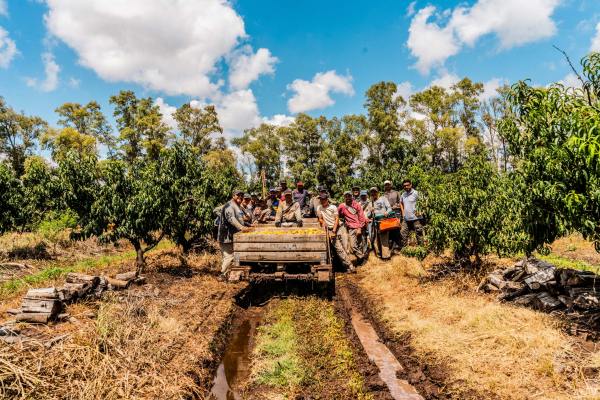
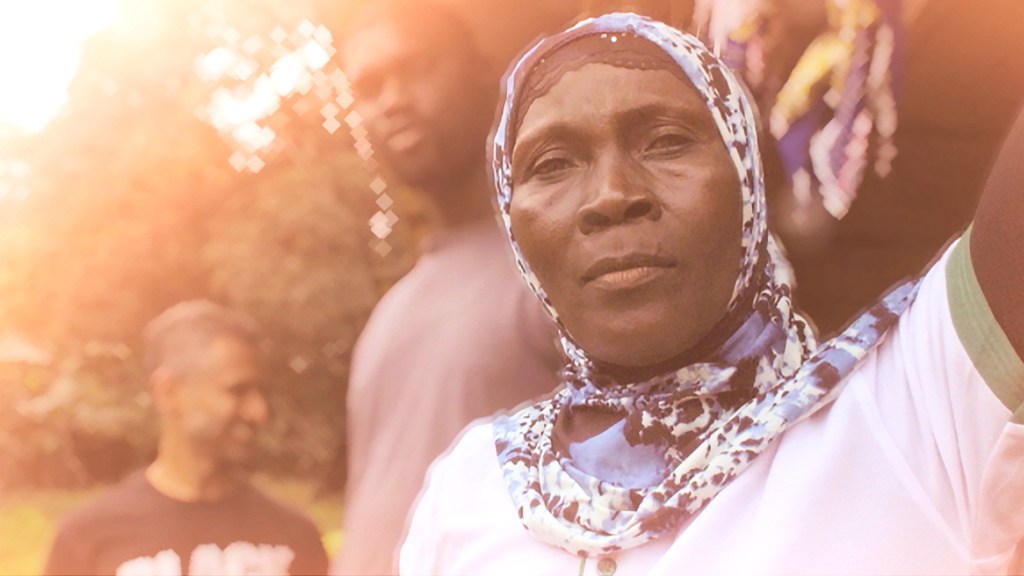
In Sierra Leone, after an 11-year civil war, the government was desperate to attract foreign investment and rebuild its economy. Most rural land was held under customary tenure, owned collectively by communities and administered by their chiefs. Binta Jalloh lived in one such community in the Eastern province, where she farmed the land for sustenance. Then one day, she heard of an agreement that would take her land away. Government officials had appointed an interim chief from outside her community. Behind closed doors, he pressed his thumbprint to a 50-year lease, signing away 75,000 acres of rainforest to a European oil palm company for just $2 per acre per year. Twenty thousand people, including Jalloh, lived on the land, and none had been consulted.
Jalloh was not going to let her community lose their land. Together with her neighbors, she reached out to a pair of community paralegals working with the Sierra Leone affiliate of Namati, an international nonprofit dedicated to social and environmental justice. They tracked down the lease, translated it into plain language, and mapped its clear violations of Sierra Leonean law. The community organized, demonstrated, and confronted the chief and the company. Some who spoke up were detained, but they did not relent. After a few years, the company backed down, and the land grab was reversed.
See how leaders worldwide are connecting local solutions
From grassroots organizing to global policy change, People-Powered Solutions highlights efforts to protect community voices and agency across the world.
“Mrs. Jalloh told me, ‘I learned that no one can bend my hand. No one can take my rights. No one can take my land,’” said Vivek Maru, the founder and CEO of Namati. “When ordinary people learn and invoke the rules, and combine that knowledge with their own people power, it is possible to squeeze some justice out of a broken system.”
Namati calls its approach legal empowerment: democratizing the law so ordinary people can wield it themselves. Community paralegals are the bridge: They are individuals who live and work within the same social and geographic contexts as the communities they serve. They combine formal legal training with intimate knowledge of local realities and a commitment to the common good. One of its core beliefs: “We can teach them law, but we can’t teach them to be from here.” This rootedness allows them to demystify complex laws, translate them into everyday language, accompany people through bureaucratic mazes, and build collective power among local communities.
Namati’s community paralegals worked on over 580 cases like Jalloh’s over the next decade. The grassroots movement that grew out of those struggles helped pass the 2022 Customary Land Rights Act, one of the world’s most protective land laws.
Their work extends to health rights in Mozambique as well. Despite progressive national laws, many Mozambicans historically faced systemic barriers like bribery, drug shortages, and a lack of basic privacy when seeking medical care. To address this, Namati’s community paralegals used a legal empowerment approach to resolve nearly 73,000 cases of patient violations across the country, mobilizing a grassroots movement that secured system reforms at both the national and provincial levels. After those reforms, one province saw a dramatic rise in patient privacy in health facilities increasing from 28% to 90% in pharmacies and 63% to 81% in HIV testing rooms. By working on thousands of individual cases alongside community members, Namati’s model generates the collective learning and grassroots leadership necessary to dismantle systemic injustice.
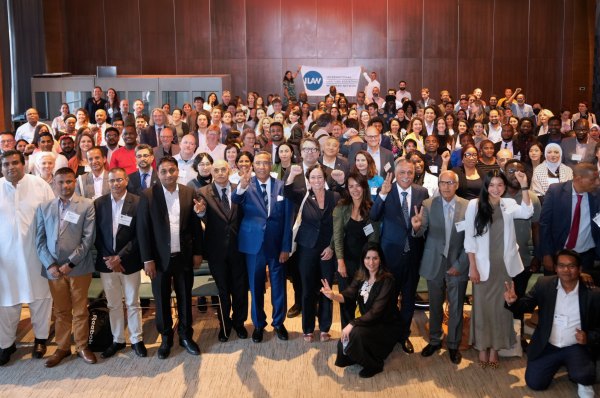
Namati believes that no movement for legal empowerment can succeed in isolation, especially in an era when progress on democracy is receding. It convenes the Grassroots Justice Network, a global community of practitioners in more than 189 countries who share findings, build solidarity, and act collectively on shared challenges. The network helped ensure justice was foregrounded in the UN Sustainable Development Goals, establishing Goal 16 on peace, justice, and strong institutions. Today, Namati and its Grassroots Justice Network continue as partners in the UN-linked Pathfinders for Peaceful, Just and Inclusive Societies and the Justice Action Coalition. Together, they push governments to fund and protect grassroots justice defenders working to close the gap that leaves 5.1 billion people across the world without meaningful protection under the law. The work also extends to the United States, where Namati partners with the Bernstein Institute at NYU Law to grow a national legal empowerment network of organisers, lawyers, and community members responding to threats facing American democracy.
In Sanskrit, Namati means “to bend something into a curve.” It is a response to Dr. Martin Luther King Jr.’s observation that the arc of the moral universe bends toward justice. But as Maru said, “The arc doesn’t bend on its own. We have to bend it.”