
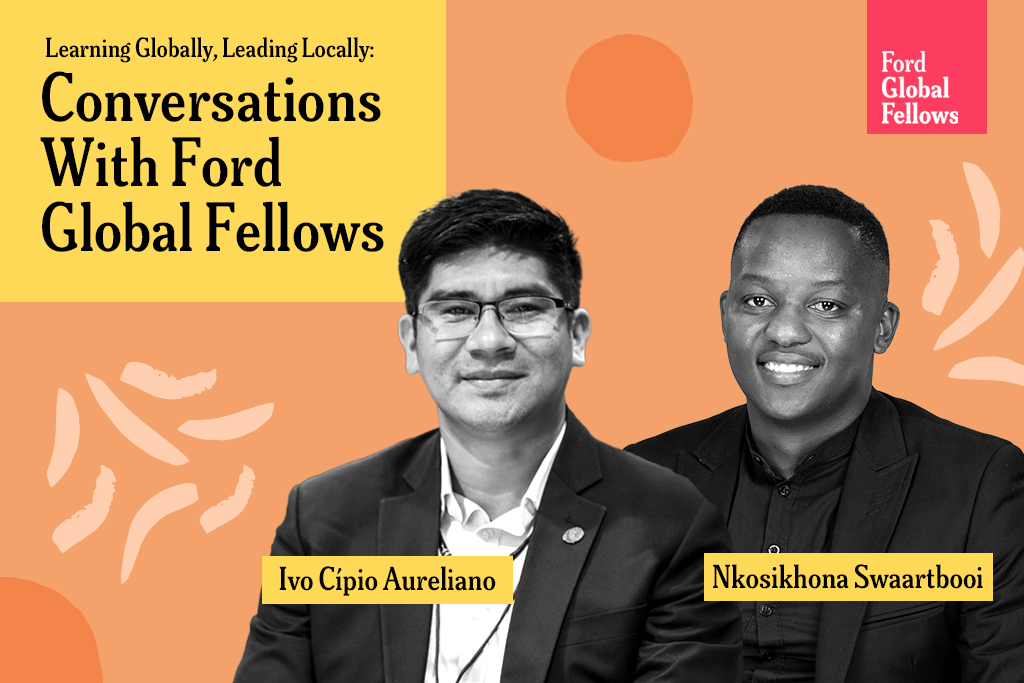
One of the most powerful ways to end inequality is to heal the foundational pain in a community. This dialogue—the second installment of Ford’s “Learning Globally, Leading Locally: Conversations With Ford Global Fellows” series—convenes two fellows whose work demonstrates how legal advocacy, grassroots organizing, and empathetic communication can address causes of injustice across continents and generations.
Ivo Cípio Aureliano advocates for Indigenous Peoples’ rights across Brazil. As a lawyer for the Indigenous Council of Roraima in Brazil’s Amazon region, he fights to ensure equality in land demarcation, territorial management, and customary law. His work has taken him to Brazil’s Supreme Court and international forums including the Inter-American Commission on Human Rights. Ivo envisions a future where national leaders respect Indigenous ways of life and recognize Indigenous Peoples as essential partners in combating climate change and preserving biodiversity.
Across the Atlantic, in South Africa, Nkosikhona Swaartbooi is a human rights activist and strategist fighting to end spatial apartheid—the physical segregation that continues to divide communities along racial and economic lines. Working with Black and Brown communities in Cape Town, he focuses on equitable access to basic services while navigating the complex relationships between communities and state institutions. His advocacy was featured in the documentary Mother City, which examines Cape Town’s legacy of apartheid and its contemporary affordable housing movements. As cofounder of Role Models, a community nonprofit, Swaartbooi cultivates positive male leadership in townships, teaching men to combat gender-based violence, femicide, and patriarchy while addressing the mental health crisis among young men.
During a recent conversation moderated by Adria Goodson, director of the Ford Global Fellowship, Ivo and Nkosikhona discovered profound connections between their different yet parallel work. As they demonstrate, lasting societal change requires both outward action—legal advocacy, organizational development, resource mobilization, and cultural and policy transformation—and inward work, repairing communities’ deepest traumas and honoring ancestral wisdom.
Holding Space for Healing Within Advocacy
Adria Goodson:
“Nkosikhona, you’ve been traveling globally with the Mother City documentary while supporting housing occupations in Cape Town, and you cofounded Role Models to work with young men on healing justice. Ivo, you recently spent weeks deep in the Amazon with Indigenous elders, building networks and sharing legal strategies. What strikes me is that you’re both creating pathways for healing alongside your advocacy work. How do you see healing justice fitting into your broader mission to disrupt inequality?”
Nkosikhona Swaartbooi:
“In South Africa, colonialism and apartheid were a targeted effort to separate families; men were allowed to work in cities and women were not. This created a state of fatherlessness where fathers exist physically but don’t understand the deeper meaning of nurturing. Through Role Models, we’re working with young Black and Brown men in townships, using soccer as an entry point. We hold space for them to play soccer, yes, but also to debrief trauma and reclaim the softness of men—their capacity for kindness and care. We need to improve the mental wellness of young men and boys, particularly in South Africa and in Africa, where men, and particularly Black men, are seen as violent beings. We need to work to reclaim our identity and lead the fight against gender-based violence. We cannot expect women to be the ones at the forefront of the struggle when they are victims or survivors of crimes committed by our male counterparts; men must lead this fight, guided by women’s wisdom.”
Ivo Cípio Aureliano:
“It’s about our vulnerability and how we can try to heal ourselves, our bodies, our minds. As Indigenous People, we’re strongly connected to our lands and nature. When we’re out of our land, we feel weakened. Our healing strategies—our songs, rituals, prayers, and traditional medicines—become even more important. I’ve been traveling throughout the Amazon to learn how different Indigenous groups maintain their traditional practices to heal their people, even when living in cities. The challenge is: How do we strengthen these traditional ways of healing ourselves in the context of globalization and new technologies? Women have a very important role in this conversation, because they’re the ones that really feel the violence and the change of culture that affects them and the children.”
Harnessing Ancestral Wisdom in Modern Movements
Adria Goodson:
“Who is a person or a source of inspiration that has served as a signpost for you in your work?”
Nkosikhona Swaartbooi:
“For me, it is my mother. She was a community leader, and she died when I was seven. At her memorial service, people were singing struggle songs, which connected to our Xhosa tradition of using song to express what we can’t say in words. We have traditional songs called amagwijo; when young men can’t find their voice to apologize to their mothers or express themselves fully, these songs give them space to communicate in manners that are very beautiful and powerful. Every time I do this work, I remember that I’m advancing work that my mother started; I didn’t choose it. Nothing else excites me or makes me happy the way this work does.”
Ivo Cípio Aureliano:
“Wow! That’s very strong. I am the only son of my father and my mom and I have seven sisters, so I was strongly influenced by women to understand myself as a person in this world. My mother always told me, ‘You will always be a Makushi person, even though you speak other languages. Don’t talk to me in Portuguese, only in our language.’ I understand now that language isn’t just communication; it’s a way to understand life and how you relate to others. In our community where we had no electricity, no Internet, no TV, we used to just sit and hear stories from our elders. I can now share those stories with people around the world. I feel that my ancestors are very happy that someone is trying to make a change and is listening to their voices.”
Becoming a “Conversational Activist”
Adria Goodson:
“When you joined the Ford Global Fellowship, we did not assume that we knew what you wanted to learn with each other or what you wanted to do with it. The Ford Global Fellowship experience is co-created with you; for it, you travel to three places and examine what they mean for your work to disrupt inequality in your own context. So I would like to discuss where your curiosity has taken you.
There’s a wonderful Nigerian philosopher, Bayo Akomolafe, who has a quote that goes, ‘When you ask a question, you speak for an ecosystem, not just for yourself.’ When you began your fellowship, what was the question that was on your heart or your mind regarding your work to disrupt inequality? And what questions are on your mind now?”
Nkosikhona Swaartbooi:
“I wanted to build bridges so that I could be able to expand the work that I’m doing in South Africa. So I asked: How does land injustice and lending housing injustice manifest in Brazil, in the UK? How do I understand other contexts globally? The fellowship provided the space to engage with the practitioners that are doing that work around the world.
One of the things that I’m coming to realize is that we need to think about what we can learn from people we deem our opponents. I’m starting to become a conversational activist; I’m starting to say, ‘Let’s have conversations even with those that we don’t like and find ways where we can understand each other.’ A just and equal society can mean something different from one person to the other. I’m more interested now in reasonings and conversations in terms of how one arrives at their decisions, so perhaps I can learn from them as a way of trying to advance the causes I am committed to.”
Ivo Cípio Aureliano:
“Joining Ford Global Fellows felt like kicking down a door and saying, ‘Things can happen if we believe.’ And it made me wonder more about community: Can we be reconnected to our ancestors and be part of a different, shared community?
I’m trying to experiment with sharing stories that can touch their heart. I hope that if we share our stories with the right people, they can influence others who have the power to make decisions. These can complement our strategies as Indigenous Peoples to introduce people to our land so they can see how life is different for us and how they can be a part of it. We can all be part of the same place and respect one another.”
Passing the Torch to Future Leaders
Adria Goodson:
“These questions you both are asking are the questions, perhaps, of our lifetime: How can we live with each other when we have someone who’s identified as an opponent? What is it that they’re doing right, and how do we create empathy and some sense of connection in our shared humanity?
As we close, what wisdom would you share with incoming Ford Global Fellows who are about to begin this journey?”
Ivo Cípio Aureliano:
“Three things: Reflect more about yourselves, be good observers, and try to act. Don’t feel you have to do something immediately. Be good observers, reflect, meditate, then act and do your best.”
Nkosikhona Swaartbooi:
“Come as you are. It’s only when you’re authentic that your needs will be understood and you’ll find what you’re looking for. Be open to unlearning, because most issues come from people not wanting to learn new ways of doing things. Listen actively and deeply with care. Don’t be afraid to be vulnerable; you’ll find that on the last day of each gathering, there are some tears being shed. That’s the culture of this community.
Resist the urge to compare yourself to others. Build relationships, not just networks; meaningful relationships will last your whole life. This community will carry you. When my nephew drowned in an open municipal manhole and my grandmother died two days later, after I’d spent 10 years advocating for clean sanitation, I wanted to give up activism entirely. But the relationships I’d built in this community carried me with care and love through the lowest point of my journey.”
Ivo Cípio Aureliano:
“My mom told me when I was a kid that our dreams show us the future. We must reflect on our dreams and listen to our ancestors’ voices through them. I strongly believe that our dreams are part of the technology that our ancestors use to pass on to us knowledge, courage, hope, and love so we can be who we are together.
Thank you for being you, and I think we are dreaming together.”

This post is part of a conversation series with Ford Global Fellows. Read more.