In 1944, delegates from 44 countries gathered at Bretton Woods in New Hampshire, laying the foundations for a postwar international economic and financial order amidst widespread devastation. Yet with much of Asia and Africa under colonial rule, the majority of the global population was not represented in shaping this new order.
Today, this postwar system continues to shape the framework of international cooperation. Despite the limits of its design, explained Alexia Latortue, head of secretariat at the Future of Development Cooperation Coalition, “This system has delivered well, but it has reached its natural shelf life as the world is radically different now.”

See how leaders worldwide are connecting local solutions
From grassroots organizing to global policy change, People-Powered Solutions highlights efforts to protect community voices and agency across the world.
The Coalition emerged from a growing recognition among governments, the private sector, and civil society that while international cooperation has contributed to extraordinary gains, its traditional operating model no longer fully reflects the world in which countries are pursuing development. Countries now contribute to and benefit from cooperation in multiple ways, new actors and resources have entered the system, and demands for greater legitimacy and agency have grown. The Coalition recognized this as an opportunity: All countries, with leaders from all sectors of society, can co-create a new development cooperation system that is more effective, efficient, legitimate, and serves all people better.
“We’ve seen enormous improvements globally,” explained Radha Rajkotia, director of research at the Coalition. International cooperation, she noted, has contributed to improving global health and reducing extreme poverty globally. “Still, there’s an over-indexing and maybe a misperception around the causes of that being international aid,” she said.
Under the postwar framework, wealthy nations utilized external assistance as a tool for reconstruction and economic development, but also for geopolitical influence. As countries across Asia and Africa gained independence, these new sovereign states entered an international system defined by a donor-recipient model, where one side provides and another receives, often with significant conditions attached.
“This view of the volume of aid and the donor-recipient framework being the dominant driving force creating improvements is mistaken,” said Rajkotia. Countries increasingly draw on domestic revenues, pension and sovereign wealth funds, remittances, trade, and private investment alongside concessional finance, while knowledge and technology also play critical roles. Global rules governing taxation, trade, debt, and finance influence the resources that are available and how effectively countries can use those resources and capture the value they generate.
This is an entirely different understanding of development and the purpose of development cooperation. “When the Coalition thinks about development, we don’t think of development as an industry or as a sector,” said Rajkotia. “We think of development really as that long-term structural capability that a country has to support its population and uphold its well-being and welfare.” For the Coalition, development is ultimately about whether a country becomes progressively more capable of delivering prosperity, services, and well-being through its own systems, with international cooperation playing a key enabling role.
Yemi Osinbajo, former vice president of Nigeria and co-chair of the Coalition, elaborated: “Countries of the Global South are bringing their own ambitions, capital, institutions, and ideas. They are not waiting to be invited into someone else’s model of development. The task of cooperation is to support that agency so they are co-authors of the rules, not simply participants within them.” According to Arancha González Laya, former foreign minister of Spain and co-chair of the Coalition, “Development cooperation cannot be renewed by changing its language while leaving its power relationships untouched. A credible system must begin with countries’ priorities, make room for shared decision-making, and judge success by whether cooperation strengthens their ability to shape and deliver their own future.”
The Coalition’s research supports this vision: Its review of development strategies across 30 low- and middle-income countries found a clear emphasis on the importance of structural transformation, including through industrialization, infrastructure, human capabilities, climate resilience, and technology. The review also affirmed that countries’ priorities extend well beyond traditional aid categories. Aid remains indispensable, particularly for the poorest, most fragile, and crisis-affected countries, but aid instruments alone cannot meet the full range of countries’ ambitions. Externally driven programs can also be undermined by short project cycles, fragmentation, high transaction costs, and demands that drain limited institutional capacity. Global economic structures have also created an unlevel playing field. All of this demands a fundamental reimagination of the system, according to Latortue and Rajkotia.
The Coalition’s work is focused on doing just this. To guide the shift to a vision of countries building their own institutional capacities and pursuing long-term transformation, its work is organized around four core questions designed to challenge the traditional donor-recipient paradigm and put country ownership and agency at the center: What is the purpose of development cooperation? Who decides the rules and sets the agenda? What financial and non-financial resources matter? And what delivery models improve impact, effectiveness, efficiency, and scale to deliver lasting change?
The Coalition’s structure reflects this approach. Its commissioners come from diverse geographies, including the majority rooted in the Global South. Co-chairs and commissioners bring experience from governments, international institutions, business, and civil society, but they participate in their personal capacities rather than as representatives of those organizations. This structure allows the group to draw on institutional knowledge without being bound by institutional mandates and to pursue questions wherever they lead. The Coalition is also deliberately time-bound: It will conclude at the end of 2026, creating urgency and an orientation toward action.
“We want to create a space that’s independent enough to ask the difficult questions, connected enough to influence decisions and decision-makers, but also temporary enough to remain focused on action,” said Latortue. Crucially, the active engagement of 20 and counting diverse supporting countries demonstrates the broad, cross-regional buy-in and political will necessary to drive systemic reform. This direct government involvement will help make sure the Coalition’s work remains a practical, actionable effort rather than an academic exercise.
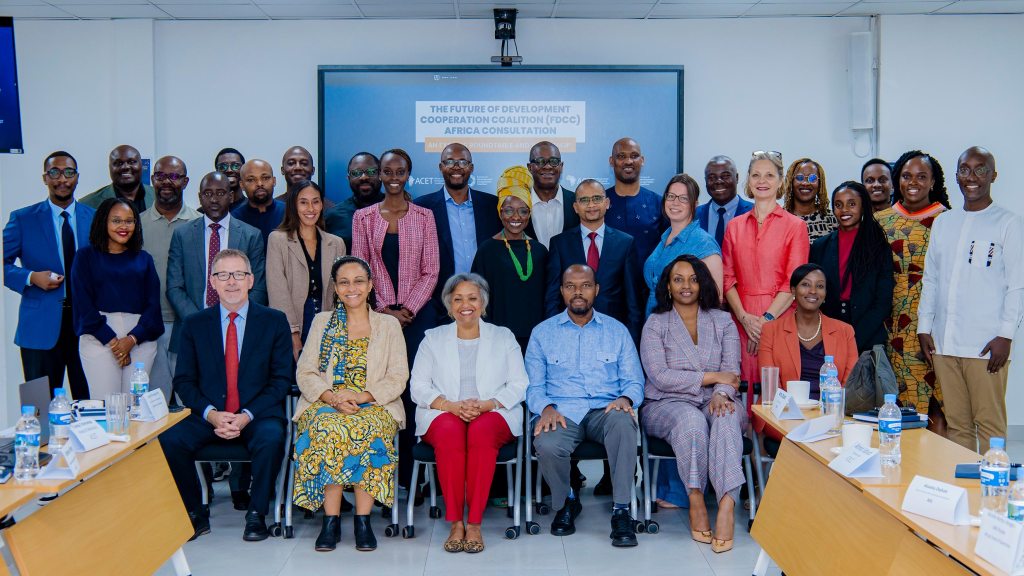
Six regional consultations have so far reached more than 500 stakeholders across multiple continents, including entrepreneurs, youth leaders, civil society organizations, academics, philanthropies, and practitioners. In Kigali, Rwanda, more than 90 participants from 20 countries surfaced examples of what is already working, from locally led and locally financed initiatives to knowledge-sharing partnerships, infrastructure investments, and small-business support. These country consultations form part of a wider engagement process that also includes thematic workshops, high-level meetings, institutional dialogues, and one-on-one conversations with leaders and practitioners across sectors.
Jeanette Thomas, director of strategic communications at the Coalition, noted that the consultation findings are informing the Coalition’s principles and the development of its recommendations, which will be finalized by the co-chairs and commissioners and published by the end of 2026. “The ambition is to create a route from what people know, need, and are already building on the ground to the global policies and practices that ultimately shape their development,” said Thomas.
This work is a contribution toward a reimagined approach to development cooperation—one in which countries have greater agency, partnerships are more equal, and success is judged by whether cooperation strengthens lasting capability and improves people’s lives.