More than 14 years ago, in Nepal’s Kapilvastu district, Laxman Belbase ran a unique workshop: He gave baby dolls to groups of men to carry for four days. For the participants, who ranged in age from thirty-something to grandfathers, the exercise became a period of self-reflection and learning. Men who had been raised to believe that caring for a child was “women’s work” suddenly realized they were not only capable of it, but they got joy from it. Assuming the role of “sole caregiver” and engaging in facilitated conversations about what the experience meant to them helped shift their understanding of parenthood. “I enjoyed it, and I am able to do it,” Belbase recalled them saying. “I should have shared this responsibility with my partner. Why hadn’t I done it?”
By reframing nurturing and caregiving as a shared human capability and responsibility, initiatives like this challenge stereotypical norms of manhood and the patriarchal legacy that shapes men’s role and understanding of care. The push to transform societal institutions and unequal power relations between women and men first gained global backing in the early 1990s. It was the culmination of a decades-long struggle by feminist and social justice movements, whose challenges to patriarchal systems that denied them dignity and freedom finally broke through at two landmark gatherings: the 1994 International Conference on Population and Development in Cairo and the 1995 World Conference on Women in Beijing. These global conferences affirmed women’s rights as human rights, elevated reproductive rights globally, and officially recognized the urgency of working with men and boys to achieve gender equality.
In response, activists, researchers, and individuals from local civil society organizations across Africa, Asia, Latin and North America, the Caribbean, and Europe began to connect. Over the years, they built a community for shared learning and collective actions. What began as an informal community of practitioners in 2003 grew into a global cohort, MenEngage Alliance, spanning more than 1,000 members across more than 90 countries. Their common purpose: to bring men and boys into the work of advancing gender justice for all.
See how leaders worldwide are connecting local solutions
From grassroots organizing to global policy change, People-Powered Solutions highlights efforts to protect community voices and agency across the world.
Stereotypes about what it means to be a man often encourage men and boys to condone violence and close themselves off from healthy intimate relationships. But according to Belbase, now global co-director of MenEngage Alliance, men and boys are not born with these patriarchal notions; these are socialized into them. Their natural tendency to seek physical and emotional intimacy is often discouraged in favor of stoicism, autonomy, and independence, which too often leads to isolation and loneliness.
MenEngage Alliance believes that what is learned can be unlearned, and that the transformation starts with self-reflection. Seeing how violence has shaped their own lives, men begin to recognize how it falls disproportionately on women and girls, and reckon with their roles as perpetrators or bystanders. This builds a sense of responsibility: seeing caregiving, for example, as their role, not as a favor to women. From there, the change ripples outward, carried by each man into the institutions he is part of.
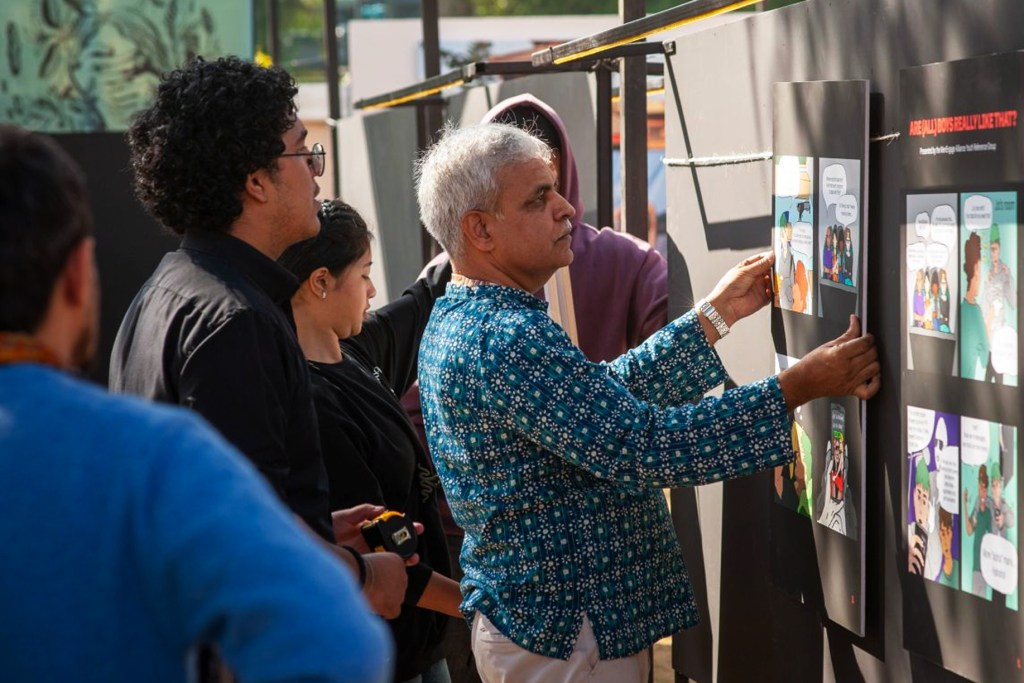
Across cultures, men and boys lack safe spaces to be honest with one another about how they are doing, observed Joni van de Sand, co-director of MenEngage Alliance. For years, members across the network have worked to meet men and boys where they are, including workplaces, sports venues, and online forums, using skilled facilitators to spark conversation. As van de Sand explained, “When they hear the experiences of queer and trans people and women and girls of color in workshops, it builds empathy that very often creates lightbulb moments, including about their own experiences as men and boys.”
Today, even as harmful misogynistic messaging floods the spaces where boys and men gather online, the Alliance stands as a counterforce.
Engaging boys and men is not an end in itself. It is a path to working in partnership with women, girls, and LGBTQIA+ people to advance gender equality, human rights, and justice for all. In policy spaces, the Alliance acts as a supporting voice for feminist demands rather than an independent interest group, developing advocacy efforts in close partnership with feminist actors. “We are trying to bring boys and men into the feminist movements,” van de Sand said. “We engage boys and men to realize the health, empowerment and rights of women, girls, gender-diverse individuals, and men and boys, working toward gender justice for all.”
Over the years, it has become a prime space where members meet, share information, exchange promising practices, empower each other, and embark on partnerships for joint research, programming, and advocacy. “The alliance has evolved to play a pivotal role,” Belbase said. “Work with men and boys has grown significantly in size and scope over the past decade in matters of violence prevention, health, and gender equality thanks to the devoted work of civil society organizations in partnership with the Alliance.”
Building on the ground won by feminist movements, the Alliance has helped deepen how global policy addresses the role patriarchal masculinities play in sustaining inequality, championing that men and boys must be part of the solution. The wide-reaching Alliance consolidates the local insights of its members to inform multilateral negotiations, including in the Commission on the Status of Women, UN Human Rights Council, UN climate change conferences, and other multilateral arenas. Notably, in 2025, the political declaration commemorating the 30th anniversary of the Beijing Declaration and Platform for Action became the first to call on governments to design and implement policies engaging men and boys to accelerate the gender equality agenda set in 1995—an important testament to the Alliance’s work.
MenEngage Alliance believes well connected social justice networks, built on the principles of shared leadership, dialogue, and collaboration, can create a force larger than the sum of its parts and lead to lasting, transformative change. By bringing together diverse actors pursuing a common purpose, this global network helps members leverage their collective skills, expertise, and resources to expand their impact and accelerate change. Three decades after the Cairo and Beijing conferences first enlisted men and boys in the struggle for gender equality, the Alliance carries that mandate forward, inspiring generations to work for a just and equal society.