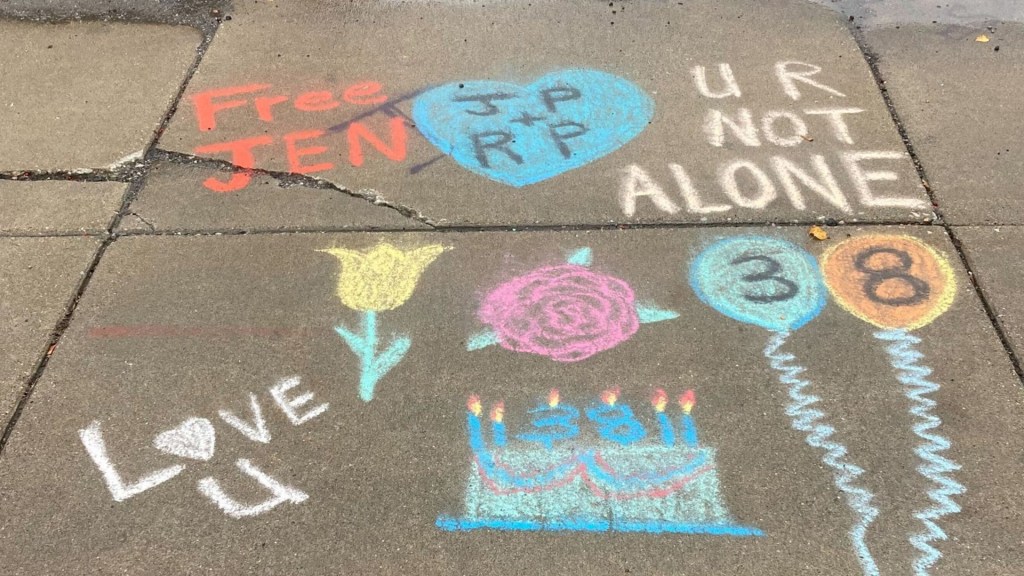
“Ever since my dad went to jail, I haven’t been able to hug him, touch him, or be in the same room as him. I feel our relationship changing,” said 15-year-old BaKari Jacoby Etter. His father is detained in Solano County, where a 30-minute video call to loved ones through iWebVisit can cost as much as $5.70 to $9—funds that could have otherwise gone to food, clothing, and other basic needs.
Every day, thousands of people across the United States pay the cost of a carceral system—not just with money, but with loss of community and connection. It’s not just expensive calls while in jail: Traffic tickets, fines, and court fees all turn into heavy burdens for people already living on tight incomes.

See how leaders are safeguarding the rule of law
To protect Democracy and Rule of Law, Ford Foundation highlights efforts to support the local officials and advocates who ensure every American vote is counted.
Since 2016, Civil Rights Corps, a Ford grantee, has challenged the structural inequities created by pretrial detention, cash bail, debtor’s prisons, and other legislation that places profit over justice and freedom. Here, Madhvi Venkatraman, director of storytelling at Civil Rights Corps, discusses the cost of freedom, its impacts on the rule of law, and the power of stories and partnership.
Stories That Build Empathy and Action
While our litigation can be complex and difficult to parse for folks outside the legal field, at the core of every one of our cases are people’s stories and lived experiences. Every one of our cases includes storytelling that transforms each legal victory—or setback—into something that educates and resensitizes the public to the injustice built into the legal system. That might be an op-ed laying out the moral case for our cause in plain language or a viral video that captures a part of the system otherwise hidden from view.
In our Right 2 Hug Project, we challenge people to expand their understanding of family separation to include children who aren’t allowed to visit their parents in jail, like seven-year-old J.L., whose father was detained in Genesee County. “I want to see him because he’s the best dad ever,” J.L. told the Right 2 Hug team. “I don’t understand why they won’t let [him] see us.”
Through testimony like this—by children and parents separated by jail walls, with video and phone calls as their only means of communication—we’re asking people to reconsider a basic idea: that being physically present with, or hugging, their family is a fundamental right. It’s one every family should have in an equitable legal system rooted in community health and human dignity.
We share these stories alongside our partners—organizers, public defenders, organizations, and other advocates—without whom our impact would be largely confined to the pages on which judicial opinions are written. These partnerships help keep us oriented and accountable to the communities we are seeking to support.
Ending the Price Tag to Freedom
Someone who can afford bail may only spend hours in jail, while someone who cannot may face days—even when charged with the same offense. In the United States, the extent of the punishment a person is subjected to after arrest directly depends on their access to money.
The ripple effects of even one day in jail can be devastating: A person can lose their job, their home, custody of their children, and more. Combined with increased policing in poorer communities, this spells a criminal legal system that disproportionately disadvantages people with low incomes and makes their path out of poverty even harder.
Civil Rights Corps fights the criminalization of poverty through civil rights litigation across the U.S. We have liberated hundreds of thousands of people from illegal jailing, won tens of millions of dollars for the people in our society the system has failed, and pioneered civic education and storytelling to change the way society thinks about mass incarceration and family separation.
Rule of Law Should Protect Everyone
The rule of law is fundamental to advancing equality in the U.S., but it won’t happen on its own. CRC identifies areas where litigation is required to ensure the law does, in fact, lead to justice. In addition to challenging the range of ways the law unevenly impacts people based on access to money, our work also ensures accountability and transparency from the people whose jobs are to uphold the law. For example, prosecutors across the country are supposed to represent the interests of the public in advancing justice. Our work helps ensure they don’t use their power to inflict harm on the very communities they claim to protect.
Civil Rights Corps won a landmark court ruling for transparency in New York on prosecutorial misconduct cases. The state was keeping the results of ethics complaints against prosecutors secret. Those complaints included serious misconduct allegations, such as allowing a witness to lie to the jury, concealing evidence of innocence, and unlawfully discriminating against Black jurors. In CRC v. LaSalle, the court found that the Grievance Committee can no longer conceal from public view its decisions regarding ethics complaints filed against current and former prosecutors. Judge Victor Marrero’s ruling said, “The public cannot have faith in a process that it cannot see.”
We are doing our part to secure the transparency needed to achieve equal justice under the law.