
The Ford Global Fellowship
Throughout the Ford Foundation’s history, we have invested in the individuals, ideas, and institutions that make change happen.
We believe that to create a more equitable world, we must support emerging leaders from the communities closest to the problems—the tenacious individuals with the deepest knowledge of the issues that affect them and the boldest ideas for building a brighter future for us all.
The Ford Global Fellowship is a $50 million, 10-year investment that aims to connect and support the next generation of leaders from around the world who are advancing innovative solutions to end inequality. Our flagship international fellowship focuses on shared learning across issues, building and strengthening connections across borders, and developing a supportive, interconnected cohort across a wide variety of sectors. Our hope is that the fellowship will catalyze and amplify the impact of these fellows’ work, both individually and collectively.
Since the fellowship’s launch in 2020, our community has grown to over 150 active fellows who nurture and learn from each other so they can work better, smarter, and more sustainably in the long haul. Over the course of the program, we aim to create a powerful network of approximately 200 fellows from across the globe, covering a multitude of the world’s most pressing issues.
About the Ford Global Fellowship
Transcript
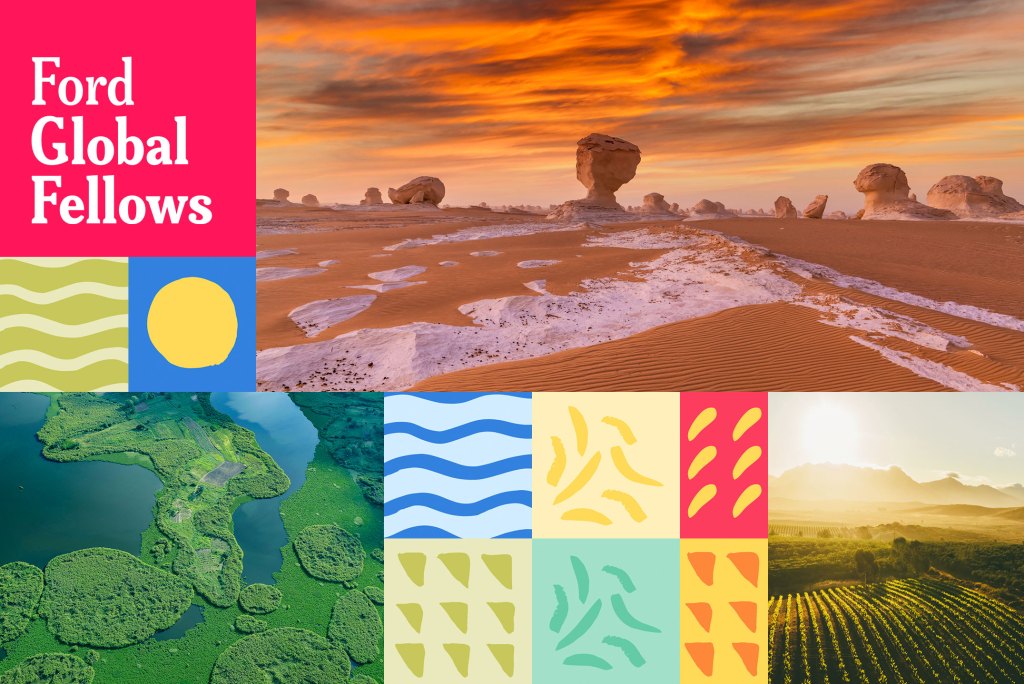
[Brightly colored tiles resembling a quilt with the text Ford Global Fellows.]
NARRATOR: The Ford Global Fellowship identifies and connects emerging leaders from across the globe to advance innovative ideas and create solutions to combat inequality. With an initial commitment of 10 years, the fellowship will support approximately 200 fellows. The fellowship experience includes three dynamic learning journeys in different regions around the world, giving fellows an opportunity to apply contextual learning to their own work. The fellows shape their own individual learning agenda, co-designing and curating the content themes and experiences to support their understanding about inequality, both regionally and globally.
[Bukky Shonibare, founder and executive director, Invictus Africa. An African woman with black skin and long braided hair.]
BUKKY SHONIBARE: The beauty of being in this fellowship is that you feel part of the creation process of the fellowship.
NARRATOR: Individuals become part of a current cohort of fellows and the broader fellowship community, consisting of past and future cohorts to create a long-term community of practice.
[Ronilso Pacheco, evangelical leader. A Black man wearing a black shirt with a gray blazer.]
BUKKY SHONIBARE To have a strong and dynamic community, global community in practice, is very important.
BUKKY SHONIBARE: That community is a community of like-minded people who, in their respective spaces, are challenging inequalities. It is trans-boundary and we can hear and learn from different contexts: how they’re challenging inequalities related to ours, tweak it within our own context, and make it work.
[Sara Curruchich Cúmez, singer-songwriter and activist. A Maya Kaqchikel woman from Guatemala with black hair wearing a traditional woven blouse.]
SARA CURRUCHICH CÚMEZ (in Spanish): You can really exchange your knowledge, your learning, and that strengthens you a lot. It strengthens you. It is like adding more force to a fire, to a collective fire. And that fire is what can generate that change we want so much. It lets us know that it is not something utopian, but that it is something that can really be achieved.
NARRATOR: Our fellowship has brought leaders together from regions where Ford operates, with more site-based and international learning to come as we continue to collaborate and learn with them.
[Ramsey Tesdell, CEO, Sowt Media. A man with light brown skin, brown hair with a beard, and brown eyes wearing a gray sweater.]
RAMSEY TESDELL: But it’s again, the idea is to make sure there’s space to elevate these questions and to make sure that we’re reporting back to ourselves, reflecting, and informing that process.
[Zhiying Ma, assistant professor, University of Chicago. A Chinese woman with shoulder length black hair wearing mahogany-rimmed glasses and a floral dress.]
ZHIYING MA: It doesn’t just welcome more traditionally defined activists or academics, but rather, a variety of people.
[Cruz Helena Valencia Moreno, cofounder, Innovation Girls. A Black woman with long braided black hair wearing a white blouse and gold jewelry.]
CRUZ HELENA VALENCIA MORENO: We are completely different. We have different cultures, different language. At the end of the day, we are working to face the same objective—that is, the inequality in the world.
ZHIYING MA: There are artists, there are academics, there are activists, there are journalists. We really learn from each other.
RONILSO PACHECO: So, different strategy, different experience, different creativity, different perspectives.
NARRATOR: All fellows have an analysis of the systems they are working to disrupt and a curiosity for developing better, deeper, more effective ways of working. In the fellowship, we do this by learning and reflecting within a global context—and then drawing insights across borders, regions, cultures, and languages.
[Chantal Wong, curator and educator. A woman of Chinese descent with pulled back hair wearing a white long sleeve top and a scarf around her neck.]
CHANTAL WONG: Every moment, I’ve learned something new, and I’ve been challenged but also just touched. And just being in the presence of incredible people and visions and dreams and experiences—together, we’re more resilient.
[Teresa Njoroge, founder and CEO, Clean Start Solutions. A Black woman with long brown hair wearing an orange and blue paisley shirt and gold jewelry.]
TERESA NJOROGE: We’ve come out strengthened, rejuvenated, stronger—with a shared, common agreement amongst us to keep going.
SARA CURRUCHICH CÚMEZ (in Spanish): Resistance is always much stronger when it is collective.
[Desmond Meade, executive director, Florida Rights Restoration Coalition. An African American man with no hair and a beard wearing a multicolored plaid shirt.]
DESMOND MEADE: We are not as far apart as sometimes we think we are, and we are not as isolated. There’s a throughline that binds us together.
[The colorful tiles reappear on screen.]
NARRATOR: The Ford Global Fellowship: a global community of diverse individuals changing the world.
FORD FOUNDATION LOGO
Accessibility Statement
- All videos produced by the Ford Foundation since 2020 include captions and downloadable transcripts. For videos where visuals require additional understanding, we offer audio-described versions.
- We are continuing to make videos produced prior to 2020 accessible.
- Videos from third-party sources (those not produced by the Ford Foundation) may not have captions, accessible transcripts, or audio descriptions.
- To improve accessibility beyond our site, we’ve created a free video accessibility WordPress plug-in.

Learning Globally, Leading Locally: Conversations with Ford Global Fellows
In this new series, emerging leaders discuss their ideas, innovations, and actions to disrupt inequality across contexts and continents.
How the Ford Global Fellowship Works
The Big Juicy Question is a practice developed by director Adria Goodson. It gives fellows tools to create and explore the questions that matter most to them.

Got questions? We have answers.
We answer frequently asked questions about the Ford Global Fellowship.