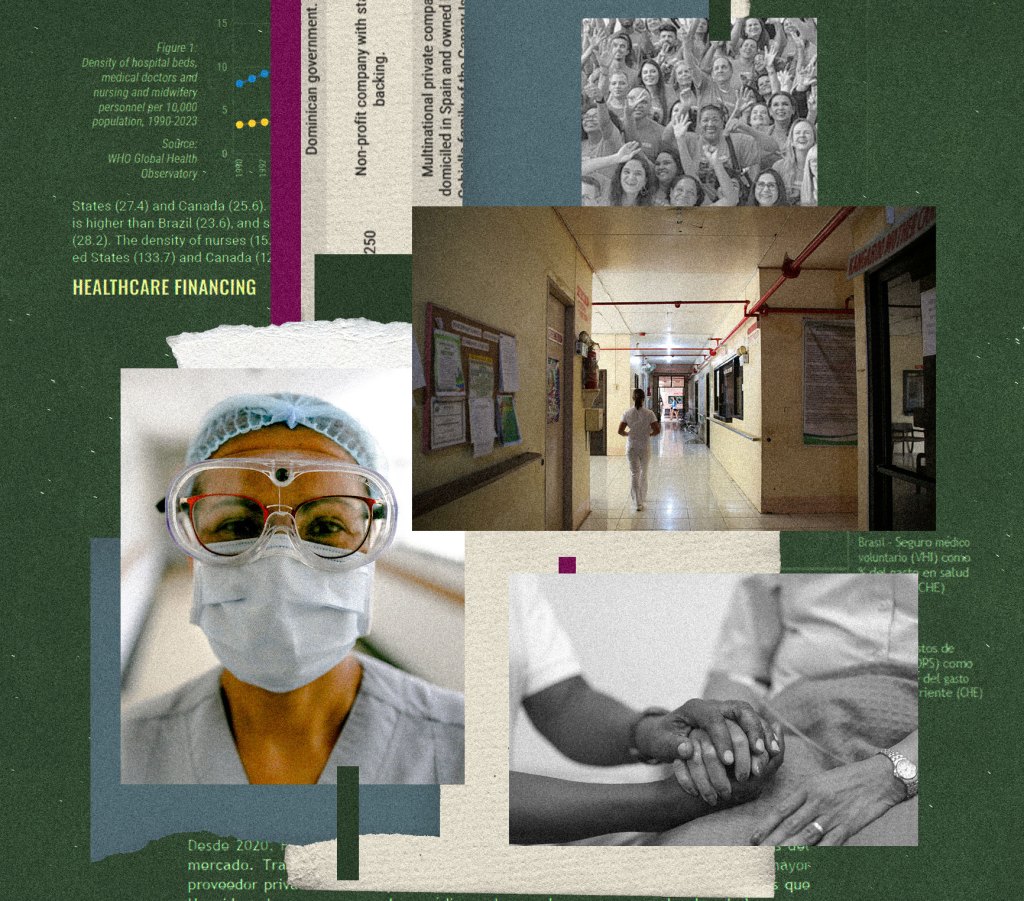
For 40 years, Grażyna has worked as a caregiver in a Polish nursing home, supporting older people with some of the most intimate and essential parts of daily life, from eating to dressing, bathing to using the bathroom. Grażyna recalls that as workers rush through their tasks, residents would often ask, “I’m lonely. Can you sit with me, even just for 10 minutes?” But spending 10 minutes in conversation with one resident often means leaving another waiting in a dirty diaper. Forced to navigate severe understaffing and too little time, Grażyna and her colleagues face impossible choices every shift. This story plays out across the care sector around the world.
Care is relational, highly skilled, and essential to every functioning society and economy. Yet around the world, care systems are being restructured into high-yield, short-term financial assets that lead to negative care outcomes for recipients and workers. As we recognize International Day of Care and Support, Ford Foundation’s Future of Work(ers) program, alongside grantee partners including UNI Global Union and economist Dr. Marina Durano, highlights the urgent need for philanthropy, civil society, and the public and private sectors to address the financialization of care and invest in a human-centered social infrastructure that supports human dignity and resilience.
The Financialization Trap: How Private Capital Targets Public Goods
“Care and support allow people to be born and grow, recover from illness, work, age, and live independently. It enables families and economies to function, and so it needs to be reliable, accessible, and accountable,” said Alan Sable, head of UNI Global Union’s care sector. It is also deeply labor-intensive and relational, and its quality depends largely on whether workers have the time, support, and conditions to care for people.
Care Economy by the Numbers
381Million care economy jobs
11.5%Total Global Care Employment
475Million Care Jobs Needed By 2030
$3.2Trillion Global Acute Care Market in 2022
Care Economy by the Numbers
381Million care economy jobs
11.5%Total Global Care Employment
475Million Care Jobs Needed By 2030
$3.2Trillion Global Acute Care Market in 2022
The care economy already accounts for 381 million jobs globally, roughly 11.5% of total employment. Driven by increasing care needs, including aging populations, the International Labor Organization (ILO) projects that 475 million care jobs will be needed by 2030. The long-term care workforce alone is projected to double by 2050. According to research by UNI Global, the global acute care market alone was valued at about $3.2 trillion in 2022, and is projected to reach roughly $4.9 trillion by 2030.
As governments commit public resources to meet rising care needs, private financial actors have taken notice. “Where public money goes, private investment follows,” explains Dr. Marina Durano, economist and director of the Collaborative for a Gender-Just Economy. Private equity firms, venture funds, and real estate investors see large, guaranteed demand backed by reliable streams of public funding. In 2022 alone, private equity investments in health care reached approximately $446 billion, according to UNI Global research. Governance around these investments is increasingly important, as it ultimately shapes how care is delivered, who benefits, and who bears the cost.
But what is financialization? Financialization occurs when financial return strategies prioritize short-term profits over quality care, working conditions, and public accountability. Across the sector, concerns are being raised about the growing influence of financial returns over how care is owned, financed and delivered. Financial actors impact care systems in a variety of ways.
In Brazil, for example, large hospital chains seeking to expand their operations take out massive loans to buy up smaller private hospitals and health insurance companies. Meeting those high monthly debt payments creates pressure to cut costs and suppress wages to service it. Because care is labor-intensive, workers are often the easiest places to extract savings. UNI-affiliated workers describe severe understaffing, more experienced staff being replaced by newer, less-experienced and lower-paid workers, and workers being required to meet time-based targets for patient care, medication, and changing linens driven by an algorithmic management system. Ultimately, these pressures shape both the quality of care workers like Grażyna are able to provide, and care patients receive.
“Where public money goes, private investment follows.”
Dr. Marina Durano
“Where public money goes, private investment follows.”
Dr. Marina Durano
But this financialization logic does not operate only by following public investment; it can also exploit opportunities created by underinvestment, weak regulation, regulatory gaps, and poorly governed financial structures. A system can therefore be publicly financed while private actors control the insurance layer, delivery layer, or both. Sable points, for example, to the use of real-estate investment trusts (REITs) in long-term care. While public regulations may cap the operational profits a nursing home operator can take, a separate REIT can own the land and buildings, charging exorbitant rents. The nursing home then pays rent to that entity, and those payments may not be subject to the same restrictions. Public money intended for patient care is siphoned out of the facility as rent, enriching offshore financial entities while care operations suffer from structural underfunding.
The Ripple Effect: Unpaid Burden and Exploited Labor
When formal systems subsequently fail to provide care, the responsibility does not disappear but moves into households, mostly on women who take on child care, elder care, support for people with disabilities, recovery from illness, and other forms of care without pay, subsidy, or adequate support. Families may sell assets, pay out of pocket, or borrow during serious illness, pushing households into credit-card debt and other forms of borrowing and producing impoverishment and indebtedness.
The harms of financialization fall disproportionately on migrant and low income workers, as well as workers of color, who are already economically and socially vulnerable and more likely to occupy insecure and contractualized care jobs, leaving them with less bargaining power and fewer protections. The care workforce is highly gendered, making women workers disproportionately impacted by the shortfalls in the system. A 2025 UNI Global report based on a global survey of 15,000 care workers in 80 countries found that more than eight in ten care workers have experienced or witnessed abuse at work. Chronic short staffing and underfunded health systems are identified as key drivers of violence where workers in understaffed facilities are twice as likely to face abuse.
A 2025 global survey found 8 in 10care workers have experienced
or witnessed abuse at work
A 2025 global survey found 8 in 10care workers have experienced
or witnessed abuse at work
Countries with weak regulation of care financing often also have weak labor-law enforcement, allowing companies to use aggressive union-busting tactics. Workers trying to organize may be fired or fragmented through individualized forms of work that make it difficult to build collective bargaining power. This weakens unionizing, a critical counterweight to actors reshaping care around financial incentives.
Financial incentives can also shape what kinds of care are provided. More complex, curative services from surgeries, cancer treatments, and advanced imaging can generate greater revenue than prevention, creating incentives to prioritize tests, procedures, and treatment over the slower work of preventing illness and supporting people before problems become severe.
Counter-Powers: Organizing, Patient Capital, and Structural Alternatives
To reclaim care as a public good, civil society and philanthropic partners must support strategies that build countervailing power and re-engineer how capital enters the sector.
Strengthening Frontline Union and Worker Power
According to Sable and Durano, worker power can close the gaps financial actors exploit. In Argentina, FATSA, a UNI affiliate, secured a national sectoral collective agreement for care workers that set standards on working hours, minimum compensation, and health and safety. Where care workers have enough bargaining power in negotiating conditions shaping their work, the system is less hospitable to highly leveraged, short-term financial models.
Strategic Interventions at Key Leverage Points
The timing of intervention is important, as there are moments when there is greater leverage to shape the terms on which capital enters care. Mergers and acquisitions, new public contracts, and proposed development-finance investments create opportunities to question how deals are structured and press for stronger commitments on labor conditions and care quality. Intervening early when financial actors remain dependent on approval, financing, or access to public funds, rather than after extractive structures have become entrenched, is an important lesson from efforts to challenge financialization.
Democratizing Finance
Reclaiming care does not require eliminating private capital or profit entirely, but rather transforming its terms. As Dr. Durano noted, “If you want profit, let’s discuss how you make that profit.”
For her, reclaiming care as a public good requires democratizing finance itself, so that the interests of women, care workers, and care recipients are structurally embedded in how capital flows into the sector and what it is expected to achieve. This is fundamentally a question of who gets to decide how credit, finance, equity, and capital are allocated, and whether those decisions produce the social outcomes people have collectively decided matter.
“Care and support allow people to be born and grow, recover from illness, work, age, and live independently. It enables families and economies to function, and so it needs to be reliable, accessible, and accountable.”
Alan Sable
“Care and support allow people to be born and grow, recover from illness, work, age, and live independently. It enables families and economies to function, and so it needs to be reliable, accessible, and accountable.”
Alan Sable
Worker representation is therefore central, but confronting financial power cannot fall to workers alone. “We can’t do it on labor alone. We can’t do it on feminists alone,” said Durano. “We really need a much broader movement.” Democratizing finance, in this sense, requires building power across social movements on a shared vision of what care, and the capital financing it, should ultimately serve.
A different financial model for care should ensure that capital in care can operate on a longer horizon. Public investment banks and mission-aligned funds can structure around lower leverage, longer repayment periods, and more patient returns, better matched to the realities of care delivery. Workers also need a meaningful role in governance, giving frontline workers decision-making power over how care institutions are run and how capital is allocated. Ownership and debt structures also need to be far more transparent to allow regulators, workers, and the public to see where financial pressure is concentrated and where public money is ultimately going. Public money should come with enforceable conditions. If private providers benefit from public funding, the terms of that funding should ensure that care quality and decent work remain central to how those institutions operate.
Costa Rica’s Banco Popular offers a practical blueprint for democratized governance. The bank is governed through a Workers’ Assembly of 290 delegates representing different sectors of Costa Rican workers, and at least half of those delegates must be women. The assembly appoints four of the bank’s seven board members, giving workers a structural voice in deciding how finance is governed and where it is directed. Banco Popular has, among other things, helped finance Costa Rica’s care system, and also offers proof that it is possible for capital in care to be patient, more accountable, more transparent, and more responsive to the people who provide and receive care.
Momentum vs. Backlash
In 2024, the International Labour Conference adopted a landmark resolution on decent work and the care economy, recognizing care as a public and economic responsibility and affirming that quality care depends on decent work for the people providing it. Its 2024–2030 Plan of Action commits the ILO to helping countries cost care systems, measure financing gaps, identify fiscal space for care investment, and develop gender-responsive macroeconomic policies.
In 2025, this gained further legal weight when the Inter-American Court of Human Rights recognized care as a human right, encompassing the right to receive care, the right to provide care, and the right to self-care. The Court recognized care as a basic and universal human need, necessary for a dignified existence, and affirmed the responsibility of states to respect and guarantee that right.
However, this momentum faces coordinated pushback. Regressive political and market narratives seek to co-opt the care agenda by reframing care as an exclusively private family duty. Rather than building durable public infrastructure, these approaches push cash-transfer micro-payments to mothers or flexible home-based gigs, reinforcing gendered inequality and leaving financialized models unchecked. In response, a growing cross-movement coalition of labor organizers, feminist economists, disability groups, elder rights advocates, and civil society leaders is confronting these narratives head-on, expanding their playbooks to challenge market-led exploitation and embed strong regulatory guardrails into a shared vision of care as a fundamental right. There are also promising emerging initiatives for engaging investors like the UNI Global Investor Initiative for Responsible Care.
The Strategic Role for Philanthropy
Building care as a public good requires backing institutions and movements with the power to defend these gains. Care workers are often confronting large, sophisticated employers, lobbies, and financial actors with very little institutional capacity of their own. In many contexts, unions are being run by workers who are still doing full-time hospital or care work, with almost no professional staff behind them.
Philanthropy can help fund the organizing infrastructures that allow workers to act collectively: supporting organizing, helping them understand complex ownership and financial structures, protecting workers against retaliation, and sustaining pressure over time.
Philanthropy can invest in research and financial analysis, providing advocates and decisionmakers with the evidence needed to expose the downstream harms of REIT structures, debt loading, and opaque ownership models. Funders can also deploy mission-aligned investments and patient capital to demonstrate the viability of non-extractive worker-governed care enterprises. Crucially, funders can serve as a bridge, connecting labor organizers, feminist economists, disability rights advocates, corporate accountability activists, and public interest lawyers into a unified funding ecosystem.
The demographic transition and the scale of the coming expansion in care makes these choices especially urgent. The task for philanthropy is to help ensure that this growth produces dignified work while ensuring that care remains accessible, affordable, and high quality. A conversation about health outcomes cannot be decoupled from the well-being of caregivers, labor structures, and care system financing. Reclaiming care as a public good is fundamentally about deciding who and what our economies are built to serve.
Reclaiming care will require supporting worker organizing and voice, strengthening corporate and investor accountability, engaging development banks so that financing serves workers and care recipients, not only market interests, and investing in the evidence workers and unions need to establish the connections between health outcomes and financing models in order to advocate effectively. By aligning philanthropic capital behind worker power, investor accountability, and democratic financial models, funders can help ensure that caregivers like Grażyna have the time, support, and dignity required to deliver compassionate, high-quality care for generations to come.