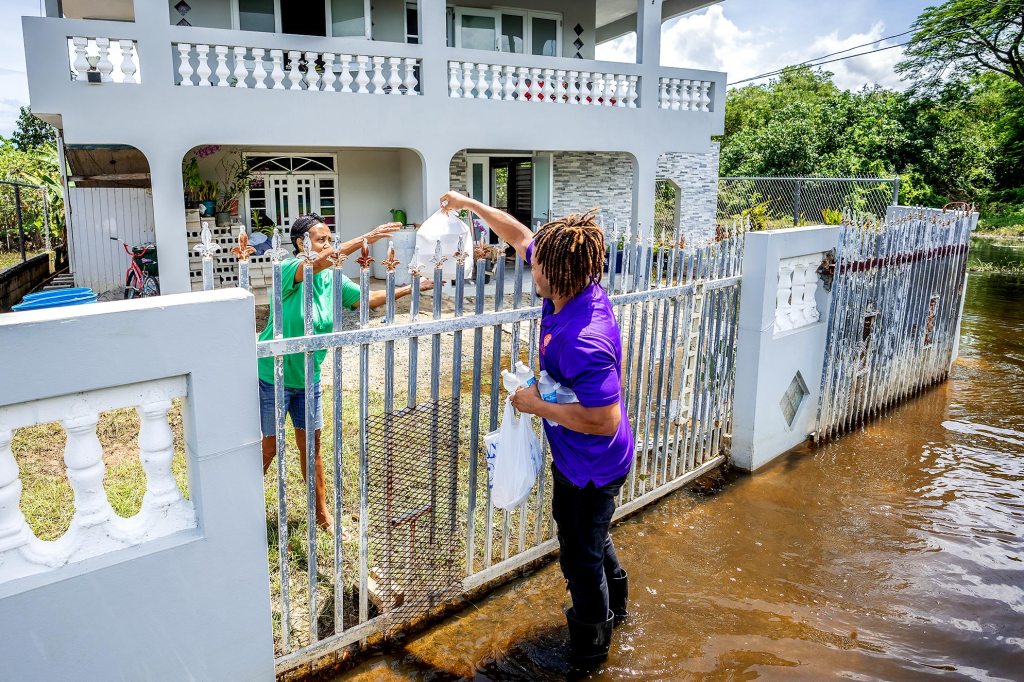
During the Fourth of July weekend in 2025, what should have been a celebration turned into a nightmare for Ashlee Willis and her neighbors in Texas Hill Country. Floodwaters came rushing into the town of Sandy Creek, where Willis and four generations of her family have lived and farmed. She woke to the sounds of screaming as friends scrambled uphill, ahead of the surging water, while pieces of cars, canoes, houses, and trees hurtled toward them. Only when four feet of water had already reached Willis’ front yard did her phone finally sound a flash flood warning.
Over that weekend, more than 22 inches of rain deluged northwest Travis County and southwest Williamson County. Nearly 200 homes were damaged or destroyed. More than 130 people lost their lives.
“Surviving the flood was just the beginning,” Willis said. “Over the last year, we’ve struggled with our insurance companies, delays, and red tape, and with an inadequate response from our elected leaders.”
Willis’ experience reflects something larger: that a community in crisis is also a community most exposed to decisions that will shape its future for decades. Whoever controls the recovery controls what gets rebuilt, and for whom. Every crisis creates an opening, and what fills it varies. As the world increasingly experiences extreme weather events, and nearly 96% of U.S. residents live in counties that experienced a climate disaster from 2011 to 2024, the question now is how society can channel its resources when calamity hits to make the most impact and rebuild better.
A Different Kind of Response
REBUILD.US was created to answer that question. Founded by leaders who experienced disasters in the United States and Puerto Rico, the nonprofit and Ford grantee mobilizes its network of more than 230 organizations with deep roots in affected communities and the capacity to provide both immediate relief and long-term organizing. Rather than waiting weeks to stand up a relief program, REBUILD.US moves money within hours of a disaster and keeps it flowing long after the news cycle has moved on.
Traditional philanthropy, which channels approximately $5 billion a year in private disaster donations, can take weeks to organize funding. Even then, some of these funds go unspent for months or years. REBUILD.US deploys funds to vetted, community-rooted organizations that are already on the ground, trusted, and actively working. The organization also reserves 30% of its funds for long-term recovery, breaking from long-held philanthropic conventions in which less than 10% of disaster funding typically goes toward multi-year efforts.
In Texas Hill Country, REBUILD.US granted $25,000 to Texas Rio Grande Legal Aid within 24 hours of the flooding. The organization provided on-the-ground legal support for disaster survivors, including help with FEMA applications, appeals, and critical documentation. With help from partners, the organization recruited more than 200 pro bono attorneys across Texas to handle urgent cases ranging from FEMA appeals to contractor disputes.
One of those cases was Justin Brown’s. After the RV he lived in was washed away in the floods, FEMA denied his application for assistance because he lacked a title for the vehicle. A Texas Rio Grande Legal Aid appeal helped him secure $35,000 to start over.
“Local groups know how to maximize the funding they receive,” said Jordan Watkins, program manager for REBUILD.US. “It isn’t going to departmental overhead or staffing. They’re able to focus it on campaigns they’re working on or immediate relief that they’re doing.”
Six months after the Texas floods, when Winter Storm Fern brought deadly snow and ice to the region, REBUILD.US moved just as fast. Within the first weekend, the Tennessee Immigrant and Refugee Rights Coalition, supported by REBUILD.US funding, mobilized 400 volunteers who distributed meals to more than 5,000 people, found housing for displaced residents, made more than 10,000 wellness calls, and sheltered more than 1,000 people.
Beyond Relief: The Long Game
REBUILD.US’s commitment to supporting long-term disaster recovery in communities is built on firsthand experience of how disasters actually unfold. In these situations, emergency needs are acute but finite. However, the policy fights that follow over housing, transit, and accountability can last years, and they tend to be won or lost in relative obscurity after media attention has faded.
After supporting Winter Storm Fern survivors in Tennessee, REBUILD.US continued investing in Stand Up Nashville, a nonprofit that is organizing survivors to advocate for a $35 million package that would give sustainable impact to the community. It funds mixed-income housing, rental assistance, legal support for people facing evictions, and an emergency reserve that would suspend transit fares during future crises.
When Hurricane Helene struck in September 2024, REBUILD.US deployed a total of $1.2 million across the region. It granted $40,000 to Down Home North Carolina within 24 hours. One hundred volunteers went door-to-door asking people what they needed and ensuring accurate information reached communities in the immediate aftermath. The organization reached more than 700 households in person and more than 250,000 by phone.
Down Home North Carolina’s membership tripled, and survivors helped secure $1.4 billion in federal relief. After a year, REBUILD.US reinvested in Down Home North Carolina’s long-term work, including disbursing much-needed relief funds.
Philanthropy’s Role
As climate change intensifies, extreme weather emergencies will only increase, bringing with them the familiar cycle of crisis, media attention, and policy fights.
To philanthropy and funders, the REBUILD.US model offers something traditional disaster philanthropy rarely can: readiness and lasting change. Rather than building from scratch each time a disaster strikes, REBUILD.US offers funders a way to activate reliable, locally based organizations that understand what recovery requires and are invested in long-haul improvements for their neighbors. Through its model, REBUILD.US is often well-positioned to be philanthropy’s “first call” when disaster strikes.
In Texas Hill Country, Willis is looking to the future, too. Since experiencing the flood in her community, she has become an outspoken local organizer, speaking in front of the Texas Governor’s Mansion to call for long-term disaster funding from state leaders. She advocates for the completion of flood-preparedness measures, including water gauges, warning sirens, and a public roadway that Sandy Creek residents can use to exit their homesteads.
“We’ve seen firsthand what happens when communities are given the tools and resourcing: We’ve become empowered, had big wins, learned to advocate for ourselves, and found support,” said Willis of her experience alongside her fellow Sandy Creek organizers. Her personal experience and insight are shaping recovery efforts that will ripple through her community’s future. And as more communities like hers take up that work, disaster recovery in America is starting to look less like a cycle that repeats and more like a system that grows stronger with each storm it weathers.